Showing posts with label Noir City. Show all posts

Sunday, December 22, 2024

Peggie Castle 1927-1973


I'm not writing much nonfiction these days because I'm busy with writing novels and teaching classes, but today is the birthday of Peggie Castle so I thought I'd post a link to the 2013 article I wrote about her for NOIR CITY magazine. The Girl They Loved To Kill: The Many Deaths of Peggie Castle is a deep dive into the haunting life and tragic career of an actress that too few people remember today. I got more than a little obsessed with Peggie when I wrote this piece, so if it reads like something of a love letter...well, that's what happens when you spend your time chasing beautiful shadows in the dark. 

Saturday, May 6, 2023

Architects of Illusion: Noir Greatest Art Directors


A film noir obsession usually starts out with a focus on movie stars. When it begins to deepen, the obsession starts to focus on the director. When it gets bad enough, it spreads to an obsession with below the line talent, the names most people have never heard of. The writer, of course. The cinematographer. The producer. My own particular obsession is at the point now where I'm fascinated by the Art Director, the studio craftsperson during the classic era of noir who was in charge of designing and overseeing construction of the sets. They were as responsible as anyone for the unique visual aesthetic we call film noir. I spent a lot of last year researching and writing about these artists, and the result of my labors is a sprawling article in the new issue of NOIR CITY. It's another great issue--with a fun lead piece on "Stoner Noir" and a nice overview of the making and resurrection of one of my favorite films, Orson Welles's THE TRIAL. I'm proud that my art director article is in such fine company. 

Sunday, January 2, 2022

Consider The Cab Driver


 The new issue of NOIR CITY features my overview of the surprisingly rich history of the cab driver in noir, from 99 RIVER STREET and JOHNNY EAGER to TAXI DRIVER and COLLATERAL. Get the magazine here

Friday, March 23, 2018

Dark Blonde: The Film Noirs of Marilyn Monroe


I have the cover story in the new issue of NOIR CITY, a piece that looks at the four film noirs that Marilyn Monroe made at the outset of her Hollywood career. These films offer an interesting look at her development as an actor and as a star, and they suggest a far different kind of onscreen persona than the one that would eventually take shape in romantic comedies and musicals in the years to come.

Check it out here.

Monday, October 16, 2017

Georges Simenon: The Father of European Noir


I'm really proud to be associated with the Film Noir Foundation and its journal NOIR CITY. Published and edited by FNF honcho and host of TCM's NOIR ALLEY Eddie Muller, it's one of the best movie journals around. The new issue is out and it's pretty damn great. There two pieces by Imogen Sara Smith, who's certainly my favorite writer on film working today. She's got a piece on Jean-Pierre Melville and another on the 1929 silent noir A STRONG MAN. Alan K. Rode writes about the great, if not widely known, screenwriter Frank Fenton. And there's a lot more.

Oh yeah, there's me. I have a couple pieces in this issue. One is a epic overview of the massive influence of Georges Simenon on European film noir. Adaptations of his novels started with Jean Renoir in the early days of sound and have extended to the present, so there's A LOT of territory to cover. It was a blast to write.

The other piece is a look at the film version of ALL THE KING'S MEN, the film about a blowhard populist politician who sweeps to power by inflaming his white rural base. Total fantasy stuff.   

You can learn about about the magazine and the Film Noir Foundation here.

Friday, October 13, 2017

THE BLANK WALL, THE RECKLESS MOMENT, and THE DEEP END

above: Joan Bennett in a publicity still for THE RECKLESS MOMENT

Elisabeth Sanxay Holding's 1947 THE BLANK WALL might be the best classic noir novel that most noir fans have never read. It's a masterpiece of its kind, one the best examples of what some feminist critics call the "domestic noir," that subgenre of crime fiction and film that concerns itself with the secret world of the happy American housewife.

Holding's book was made into the brilliant 1949 Joan Bennett noir THE RECKLESS MOMENT, and was then adapted fifty years later into the excellent 2001 Tilda Swinton neo-noir THE DEEP END. Three very different works of high quality. That's an incredible feat. 

I wrote about the book and its cinematic legacy in a recent piece for the Book vs Film column for the magazine Noir City. Here's a link to the article. Check it out. 

Sunday, August 14, 2016

Noir City Chicago 8


The biggest thing that happens for me moviewise every year is the annual Noir City Chicago put on by the Film Noir Foundation at the Music Box Theater. It's a can't-miss festival of classics and oddities, and this year's line up (starting this Friday) looks amazing. Stand outs include the Charles McGraw flicks ARMORED CAR ROBBERY and THE NARROW MARGIN, the Ida Lupino rarity DEEP VALLEY, the Martin Goldsmith penned SHAKEDOWN with Howard Duff, and Bogart's last film, the boxing flick THE HARDER THEY FALL.

Here's the complete schedule of movies and showtimes.

Wednesday, October 21, 2015

NOIR CITY is here


The new issue of NOIR CITY is a real piece of work. It spotlights a few of the under appreciated women who made noir happen. Eddie Muller spotlights producer Joan Harrison, and there are pieces on Ella Raines, June Havok, and the great Dorothy B. Hughes. My own contribution to this issue is a piece on Jean Gillie and Jack Bernhard, the wife and husband team who made the most deranged of all classic noirs, 1946's DECOY.

There is much, much more by a stellar lineup of guest voices like Megan Abbott and Vicki Hendricks. Check out the issue here. 

Wednesday, July 29, 2015

The New NOIR CITY Summer Issue Is Here!


The new issue of NOIR CITY has a special focus on music. I have a piece on the country noir of Johnny Cash. It was a thrill to get to write something about the musician whose music has meant the most to me over the course of my life.

I also have a new installment in my series on Poverty Row Professionals, this time focusing on the New York filmmakers Joseph and Geraldine Lerner. They pretty much embodied the postwar East Coast Poverty Row. Among other interesting films they made one of my absolute favorite low-budget noirs, GUILTY BYSTANDER.


The issue is packed full of great articles by the likes of Imogen Sara Smith, Gary Deane, Ray Banks, Vince Keenan, Rosemarie Keenan, Woody Haut, Steve Kronenberg, and more. As usual the issue is designed by the great Michael Kronenberg.

Check it out here.

Tuesday, June 9, 2015

NOIR CITY On Sale!

I've been writing for NOIR CITY for a few years now, and I've been really happy with all the feedback I've gotten from people who love the magazine. The only problem has been that folks could only get the issues on a subscription basis.

Well, I'm happy to say that you can now buy NOIR CITY on an issue by issue basis. My contributions to these issues include an overview of Orson Welles's impact on film noir, my profiles of people like Tom Neal (DETOUR), Peggie Castle (99 RIVER STREET), Beverly Michaels (WICKED WOMAN), all the entries in my series on Poverty Row Professionals, and much more.

You can find out more, and get complete table of content listings for each issue, including great work by regular contributors like Eddie Muller, Imogen Sara Smith, Vince Keenan, Gary Deane, Steve Kronenberg, and Dan Akira Nishimura--and special features by people like Ed Brubaker, Ken Bruen, Michael Connelly, Christa Faust, Barry Gifford, Dennis Lehane, Laura Lippmann, Scott Phillips, Duane Swierczynski and many more. Every issue is beautifully designed by the great Michael Kronenberg.

Go check it out at the new Noir City website.

Saturday, April 25, 2015

NOIR CITY: The Comix Issue


The new issue of Noir City is here, and it is a beauty. Great contributions from Steve Kronenberg, Imogen Sara Smith, and Eddie Muller--and some really standout work from art director and designer Michael Kronenberg. The focus of the issue is comix and noir, and features a big interview with Ed Brubaker and Sean Phillips, the team behind the brilliant series THE FADE-OUT.

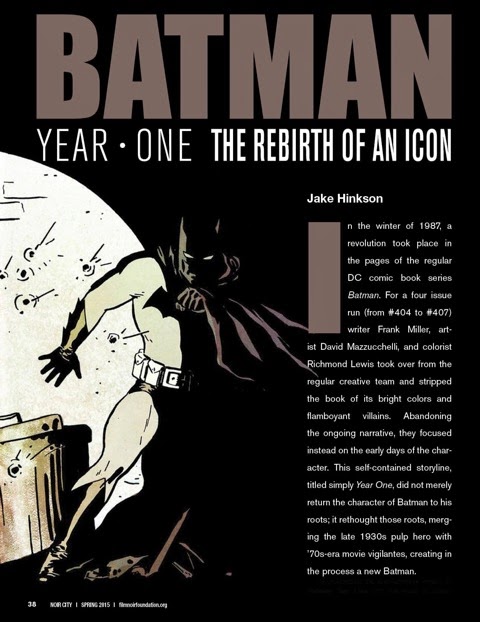
The book also features a couple of articles by yours truly: first up,  a piece on BATMAN: YEAR ONE which might be the most noir Batman story ever. 

My other article is the newest installment in my series on Poverty Row Professionals: a career overview of director W. Lee Wilder. Wilder was the older brother of Billy Wilder, and he's been overlooked for years, but he's a really fascinating figure. He stayed an independent on Poverty Row his entire career, and while his films are bargain budget productions, they have a theme so unified that it counts as an obsession: the predatory older man who stalks an impressionable young woman.

Check out Noir City Spring Issue 2015.

Tuesday, October 21, 2014

Poverty Row Professionals: William Castle

I'm doing a series on the professionals of classic Hollywood's Poverty Row for the e-mag Noir City. My first installment was on the career of the underrated John Reinhardt (THE GUILTY, OPEN SECRET). 

My latest piece is on William Castle. He's best known today for the flamboyant gimmicks he used to sell his schlock horror movies in the fifties and sixties, but in the forties he'd down a lot of work on Poverty Row and in the B-units of some larger studios. He gave us one of the first film noirs in the class of 1944 (WHEN STRANGERS MARRY), apprenticed under Orson Welles on THE LADY FROM SHANGHAI, and produced several other good examples of noir before moving on to fame and fortune as a self-crown master of the macabre.

You can check out my article on Castle by getting Noir City.  

Wednesday, August 27, 2014

Noir City Chicago 6 and The Altars of Forgotten Women


This weekend Noir City Chicago kicks off at the Music Box Theater with two of my favorite films: TOO LATE FOR TEARS (1949) starring Lizabeth Scott and Dan Duryea, and ROADBLOCK (1950) starring Joan Dixon and Charles McGraw.

I've written about both of these films on this blog (here and here), and I'd like to reprint an essay I posted here a few years ago that celebrates Lizabeth Scott and Joan Dixon.

Here's "The Altars of Forgotten Women":

One of the ironies of film noir is that many of its lasting icons were never stars in their lifetime. More than any other genre, stardom in noir is retroactive. Someone like Ann Savage had only the most fleeting taste of fame in her youth before Hollywood showed her the door. Yet, Savage was one the lucky people who lived to see her fame catch up to her. A cheap little sixty-five minute crime picture called DETOUR—a picture Savage appears in for all of thirty minutes—somehow endured and prospered over the years. Savage was in her sixties and working as a secretary when she discovered that she was at the center of a cult.

Savage’s cult is just a faction of something larger called film noir, which is, among other things, largely a cult of forgotten women. Savage was not alone in finding herself as an object of worship. Within this convocation there are many different sects, sects with passionately devoted followers. Actors like Audrey Totter, Marie Windsor, Evelyn Keyes, and Janis Carter all have legions of admirers. None of them were really stars in their day, but their movies have a life all their own. Long after their careers fizzled out, sometimes after their own deaths, some actors finally became stars. That just about defines the word bittersweet.

Of course, major stars like Audrey Hepburn and Judy Garland experience a similar life after death effect, and a select few even seem to reach beyond mere stardom and become a part of the larger shared consciousness of society. You could argue, at this point in Western culture, that Marilyn Monroe is nearly as iconic as the Virgin Mary.

Yet film noir is a genre born out of B-movie obscurity. Lizabeth Scott will never be as famous as Marilyn Monroe, but she is the ruler of her own dark little corner of Dreamtown because is the woman who most deserves the title of Queen of Noir. She starred in more film noirs than nearly anyone else, and she was also unique in that her filmography consists mostly of noirs. She only made a handful of movies that didn’t involve people betraying each other and ending up gutshot at the end. She played the entire range of characters available to women in the genre, from doe-eyed innocents (THE STRANGE LOVE OF MARTHA IVERS, THE COMPANY SHE KEEPS) to world-weary lounge singers (DARK CITY, I WALK ALONE) to cold-blooded femme fatales (STOLEN FACE). She starred in one of the genre’s real lowlights, the misogynistic DEAD RECKONING. She starred in what maybe the campiest noir ever made, the hilarious DESERT FURY. Most importantly, she starred in two of the finest noirs we have, Andre De Toth’s 1948 PITFALL and Byron Haskin’s 1949 TOO LATE FOR TEARS.

To understand the appeal of Liz Scott, one only need to look at those last two films. In the first, she plays a woman named Mona Stevens who falls into an affair with a married man played by Dick Powell. Their affair is discovered by a psychotic private detective (played by Raymond Burr) who is obsessed with Mona and proceeds to make life hell for everyone involved. The cast here is superb, and at the center , in a performance of great sympathy, is Queen Liz. She makes Mona a sexy woman (which must have been fairly easy since Scott herself was gorgeous, blonde, and had a voice that was equal parts cigarettes and silk), but she also makes Mona a sad woman. Loneliness is the undercurrent of Scott's voice, the thing that pulls you further down into her trap. Even when she’s happy, you can tell that Scott is afraid of the worst. In PITFALL, she pretty much gets the worst at the hands of thoughtless men.

In TOO LATE FOR TEARS, she gets her revenge. As housewife turned criminal Jane Palmer, Scott creates a portrait of coolheaded evil. Jane and her husband Alan (Arthur Kennedy) are driving home one night when someone tosses a briefcase full of money into their car. Is the money a payment for a ransom? Perhaps a blackmail payoff? Alan doesn’t care, he just wants to turn the money over to the cops. His wife, ah, disagrees. She’s willing to do anything to keep the cash, even after slimy crook Dan Duryea shows up looking for it and slaps her around. Neither the crook nor the husband have any idea who they’re dealing with in Jane Palmer. These guys are toast. With her performance, Scott makes a pretty good grab for the most evil femme fatale on record, yet she also makes Jane Palmer curiously relatable. Again, there’s that sadness, that aching, unfulfilled need at the center of Lizabeth Scott that comes through in her performance. Jane Palmer is evil, yes, but she’s also smart, dogged, and utterly human.

It is, after all, humanity that is the great appeal of the forgotten women of film noir, our sense that we’re seeing a human being alive onscreen. Movies of the forties and fifties were made to be dreamlike, and all these years later they still seem like dreams. The dreams hook us; the humanity makes us obsessives, worshipers at the altar. “Who was this woman?” we ask. Not just Queen Liz (who, happily, is still alive as I write this), but so many others. We watch them laugh and cry and scheme and die and then we watch them do it all over again. It doesn’t take much to hook us.

Take Joan Dixon. In 1951 she starred in a vastly underrated film noir called ROADBLOCK alongside Charles McGraw. She plays Diane, a sexy conwoman who marries a straight-laced insurance investigator name Joe Peters, a marriage that will have disastrous results. Joan Dixon strolls through this movie as if she’s one of the great femme fatales. It’s not just that she’s beautiful, it’s that she projects that essential combination of intoxicating sexual allure and an untouchable, unknowable center. Is Diane bad? It’s tough to say. Dixon might be criticized for giving a performance that's too laid back, but I would argue that very ambiguity is her greatest attribute. She doesn’t set out to ruin Joe Peters, but once she meets him, he’s a goner. It’s an interesting take on the femme fatale. Many femmes are man-eating monsters. Diane is different. She’s a catalyst who opens up all the insecurity and greed buried beneath honest Joe Peters’ upright façade. It takes quite a gal to destroy Charles McGraw. Joan Dixon does it without really trying.

One thing’s for sure: she never had much of a career in Hollywood. She started out at RKO under contract to Howard Hughes (which was not somewhere a fresh-faced twenty-year old from Norfolk, Virginia wanted to find herself). Hughes promised to build her career, but he was too busy running RKO into the ground. Dixon spent most of her time in low budget westerns and ended her acting career in the late fifties doing bit parts on television. By then, she’d become a lounge singer and was mostly notable in the newspapers for a string of quick marriages and messy divorces. She died in Los Angles in 1992.


She was no one’s idea of the queen of anything, yet she lives on in this little-seen masterpiece. Her fame hasn’t happened yet, unlike Ann Savage or Lizabeth Scott. Even in the insular world of film noir, Joan Dixon isn’t an icon—yet. I have faith, however, that her cult is coming. If there’s one thing that you can learn from the history of noir, it’s that there’s always time.

Wednesday, July 2, 2014

Midnight In America: The Film Noir of John Reinhardt

The new issue of NOIR CITY is out and it features the first installment of a new series by Yours Truly called Poverty Row Professionals. Faithful reader know that I have a weakness for the down and dirty world of B-films. I'm talking here about the cheapest of the cheap stuff that rolled out of Gower Gulch in the forties and early fifties. I'm talking Cheapsville.

First up, I examine the career of director John Reinhardt. Though he's been largely forgotten today, Reinhardt made some of the darkest, most cynical noirs of the classic period including THE GUILTY, HIGH TIDE, OPEN SECRET, and CHICAGO CALLING. Great stuff. In my research, I found some interesting bits about Reinhardt's life: he was next door neighbors with Bogart, who used to crash on Reinhardt's couch when he was on the outs with Mayo Methot (which was often); he served under John Ford in WWII and did recon missions in Mexico; and more. But the best part of writing the article was spending all that time looking at Reinhardt's work. He was the perfect candidate to kick off a series on the professionals of Poverty Row.
This issue of NOIR CITY (Summer 2014) has a ton of great material, including pieces by Dennis Lehane, Duane Swierczynski, Vince Kennan, Steve Kronenberg, Eddie Muller, and more. It's fantastic and I'm pleased as hell to be in it.

Learn how to get a copy of NOIR CITY here.