Showing posts with label comic books. Show all posts
Wednesday, October 23, 2019
Moses, Iron Man, and Jesus Walk Into A Cinema
Reading about the recent dust up between Martin Scorsese and Marvel fans, I couldn't help but think of Cecil B. DeMille's 1956 THE TEN COMMANDMENTS. It's a film that Scorsese admires and that he showcased in his documentary A PERSONAL JOURNEY THROUGH AMERICAN FILM (1995). It's a finely crafted big budget spectacular. It's also a pretty bad film. What I mean is, no one watches THE TEN COMMANDMENTS today and thinks of it in anything other than genre terms. It's not a serious statement of religious conviction, it's not psychologically rich, and it's not a great work of cinema. Instead, it's the biggest of the biblical epics, the popular movie genre that dominated big screens in the 1950s. And biblical epics were, basically, proto-superhero movies. They have most of the qualities that we associate with superhero movies: square-jawed heroes with fantastic abilities, impressive special effects, romantic subplots, broad action and drama, and characters that fall pretty easily into the categories of good and bad. (About the only thing from the standard superhero tool kit that THE TEN COMMANDMENTS is missing is comedy, because DeMille didn't have a sense of humor.) I suspect Scorsese is probably making allowances for Moses that he won't make for Iron Man because he formed an attachment to the biblical epics as a kid. As a child, he looked past their goofiness and their shallowness because all he saw was their size and spectacle. The symbolism of the Bible writ large on the big screen fired his imagination, and that initial awe and wonder has stayed with him. The same is undoubtedly true of people who love comic book movies. Where they would watch THE TEN COMMANDMENTS and might only see stodgy cheese, they look past many of those same qualities in their beloved comic book movies because they bonded with those stories and characters as children.
Something else that has inspired these reflections is that I rewatched Scorsese's THE LAST TEMPTATION OF CHRIST the other day. It's a fascinating film, and part of its fascination is that despite all of its controversy, in its heart it's kind of another cheesy biblical epic. It's dealing with deadly serious theological issues, but, I don't know, every time Harvey Keitel opens his mouth to debate Jewish law, I laugh. When the snake tempts Jesus in the desert with "Look at my breasts. Ooh Jesuuus," I laugh. And pretty much every time Peter Gabriel's very '80s score kicks in, I laugh.

Something that THE TEN COMMANDMENTS and a movie like AVENGERS: ENDGAME have in common is that they both essentially exist to do fan service. (THE TEN COMMANDMENTS was the only movie my fundamentalist grandfather liked, probably because it was designed to give him exactly the version of Moses he expected to see. Most comic book fans love ENDGAME for the same reason.) In this crucial respect, though, THE LAST TEMPTATION OF CHRIST is different. Scorsese made a film that appealed to a very narrow sliver of the moviegoing public. He made a biblical epic that would antagonize the kind of people who usually like biblical epics, without necessarily attracting many people who don't like biblical epics. Along with Kevin Smith's DOGMA, it belongs in a tiny subgenre we might call Subversive-Catholic fanfic cinema. These are works of supremely idiosyncratic theological obsession.
I don't know if the superhero movie could really lend itself to this kind of treatment. Something like UNBREAKABLE is certainly a rethinking of the superhero movie, but it's not working from well known pre-existing characters. And, no, JOKER doesn't count, either. JOKER is a massive testament to fan service. It gives fans of the character exactly what they want to see (to the tune of about 745 million dollars and counting). Perhaps one day when Iron Man and Joker and all the rest of their superhero/villain brethren slip into the public domain alongside Jesus and Moses, we'll see if something truly challenging could be done with them. That should be interesting.
For now, we're stuck with the world as it is, a world dominated by superhero movies. In a way, I'm okay with that. I like many of these movies, and I suppose that whether they wear capes or togas, superheroes have pretty much always dominated movie screens. Having said that, it's also true that most great cinema addresses itself to the rest of us mere mortals, living our little lives down here below without the benefit of either infinity stones or parting seas.
Saturday, April 25, 2015
NOIR CITY: The Comix Issue
The new issue of Noir City is here, and it is a beauty. Great contributions from Steve Kronenberg, Imogen Sara Smith, and Eddie Muller--and some really standout work from art director and designer Michael Kronenberg. The focus of the issue is comix and noir, and features a big interview with Ed Brubaker and Sean Phillips, the team behind the brilliant series THE FADE-OUT.
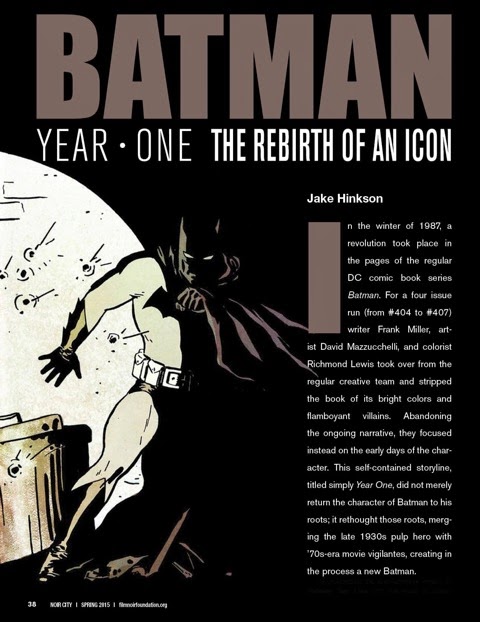
The book also features a couple of articles by yours truly: first up, a piece on BATMAN: YEAR ONE which might be the most noir Batman story ever.
My other article is the newest installment in my series on Poverty Row Professionals: a career overview of director W. Lee Wilder. Wilder was the older brother of Billy Wilder, and he's been overlooked for years, but he's a really fascinating figure. He stayed an independent on Poverty Row his entire career, and while his films are bargain budget productions, they have a theme so unified that it counts as an obsession: the predatory older man who stalks an impressionable young woman.
Check out Noir City Spring Issue 2015.
Wednesday, December 17, 2014
'Twas The Dark Knight Before Christmas: BATMAN RETURNS
I have a new piece over at Tor.com that is inspired by my recent realization that BATMAN RETURNS is both a) my favorite Batman movie and b) my favorite Christmas movie.
Check out 'Twas The Dark Knight Before Christmas.
Friday, October 31, 2014
CRIMES BY WOMEN: The Comic Book
From my new piece on CRIMES BY WOMEN:
Crimes By Women was a ten cent comic book published by the Fox Features Syndicate from June of 1948 to August of 1951. It was an anthology series that showcased a series of femme fatales, gun molls and full-tilt psychopaths engaged in all manner of sexual seduction and wanton violence. It was, in a word, trash.
Trash has its appeal, though, and—more importantly—it can tell us something about the shifting currents of a culture...
To read the rest of the piece, head on over to Criminal Element.
Friday, July 22, 2011
A Tale Of Two Heroes: Captain America and Green Lantern

I grew up reading comic books. At one time or another, I collected Captain America, Batman, Green Lantern, and The Punisher. Somewhere along the way, though, I put away most of my comic books when I became obsessed with movies and literature. Once I discovered Orson Welles and Flannery O'Connor, well comic books started to seem a little boring.
While I still feel that way, I've never lost my affection for the crime fighters in tights. I don't rush out to see most comic book movies (I haven't seen IRON MAN 2 yet, nor THOR), but I'm not opposed to seeing them. A movie based on a comic book is, to my mind anyway, as legitimate as a movie based on a science fiction or western novel.
Let's consider that last point. Those thin, colorful little "books" (actually they were usually only eight or nine pieces of paper folded double with a couple of staples holding them together) have replaced the pulp novels that preceded them as the popular driving force of low culture. The Western, god love it, is all but dead--unless it involves aliens, apparently (though, COWBOYS & ALIENS is itself based on a comic book). Somewhere along the way, the comic book movie crawled its way to the top of the money pile. While the superhero flick goes back to the forties (the first Captain America movie came out in 1944), it had to wait until the seventies rolled around before STAR WARS, special effects, and the charm of Christopher Reeve could make it a respectable bet at the box office.
Now look where we are: every week brings another damn costumed do-gooder flick. The latest, CAPTAIN AMERICA: THE FIRST AVENGER, is one of the best. It's an old-fashioned entertainment that clearly wants to be RAIDERS OF THE LOST ARK, which is a stellar aspiration for a summertime adventure movie to possess. (The movie, set in WWII, even has a couple of winking references to "Hitler digging for trinkets out in the deserts." One gets the idea that if Captain America got on a plane and flew out to the Middle East, he'd find Dr. Jones there punching out Nazis.) Chris Evans stars as Steve Rogers, a 98-pound asthmatic, who is chosen to take a Super Solider Serum. After he takes it he turns into...well, a superhero.
The movie is tremendous fun, enlivened with good humor and exciting action sequences. It has an excellent supporting cast, with Hugo Weaving as the super-Nazi villain, Hayley Atwell as the beautiful and plucky love interest, and Tommy Lee Jones as the crusty old-timer (in the old days this role would have been played by Millard Mitchell). Best of all, Chris Evans gives a star-making performance as Steve Rogers, a good man given the chance to become a great man.
Like most good superhero movies (SUPERMAN, Nolan's Batman movies), CAPTAIN AMERICA understands the character at its center. Now, that implies that there is a character to understand. (For instance, IRON MAN was a good movie because it understood the appeal of star Robert Downy Jr. The Tony Stark of the comic books was pretty thin soup). To really set itself apart, a comic movie needs an intriguing central character and a story to support him (this is a pretty male-centric world, at least so far). The makers of CAPTAIN AMERICA understand that Steve Rogers is a man defined by a bigness of spirit and a basic goodness. He represents what is, to borrow a phrase, right about America. The film is empowered by Evan's charismatic performance as Steve. I don't think I can top Slate's Dana Stevens in her description: "He's wholesome but not goody-goody, masculine but not macho, and likable without begging for the audience's love." The key to this performance is that Evans creates a consistent character, a through line from Skinny Steve to Super Steve. In both incarnations, Steve is defined by a gentleness of spirit and a sense of moral responsibility. Square? Sure, but Captain America was always square. That's the point. He doesn't need to wink at you to let you know he's not really that guy. He really IS that guy.

Contrast this with GREEN LANTERN, which stars Ryan Reynolds as Hal Jordan, a callow test pilot who is chosen by an intergalactic alien police force to wield a green power ring which can do pretty much anything the bearer can imagine. In a sense, Jordan's journey mirrors that of Steve Rogers. Both are chosen to become heroes by forces beyond their understanding. Both rise to the challenge and defeat evil enemies.
The differences between the two are important, though. GREEN LANTERN is hampered by the fact that its main character is something of a blank slate. Ryan Reynolds gives it a good try, but he can't seem to find any real spark in the character. This might not be his fault. As a kid, I collected both CAPTAIN AMERICA and GREEN LANTERN. The difference between the two was this: with Cap, you daydreamed about being Steve Rogers; with GL, you daydreamed about what you'd do with the ring. No one dreams of being Hal Jordan.
GREEN LANTERN has been criticized for being a lumbering, effects-driven, corporate concoction designed only to be a big tent-pole summer blockbuster. I won't fight too hard against that description (except to say that, in all honesty, none of these movies are Cassavettian labors of love). In a way, though, it's really more of a fanboy movie. As I watched it, I wasn't angered by its machinations--I was reminded of the geeky joy of the comic. GREEN LANTERN is a triumph for the Comic-Con crowd, whose influence is perhaps disproportionate to their store of original ideas. Watching this movie I was reminded of something Roger Ebert wrote about the 2003 Civil War flick GODS AND GENERALS: "(It) is the kind of movie beloved by people who never go to the movies, because they are primarily interested in something else." GREEN LANTERN is a movie for people who love comic books, not cinema.
One can, of course, love both. I hope I've been clear in my admiration for comic books. (If not, please read this.) Despite some similarities, however, comics and movies are different mediums. CAPTAIN AMERICA plays like a real movie, bridging the gap between its pulpy roots and its Indiana Jones aspirations. GREEN LANTERN plays like a 200 million dollar comic book.
Subscribe to:
Posts (Atom)