Showing posts with label Orson Welles. Show all posts

Saturday, May 6, 2023

Architects of Illusion: Noir Greatest Art Directors


A film noir obsession usually starts out with a focus on movie stars. When it begins to deepen, the obsession starts to focus on the director. When it gets bad enough, it spreads to an obsession with below the line talent, the names most people have never heard of. The writer, of course. The cinematographer. The producer. My own particular obsession is at the point now where I'm fascinated by the Art Director, the studio craftsperson during the classic era of noir who was in charge of designing and overseeing construction of the sets. They were as responsible as anyone for the unique visual aesthetic we call film noir. I spent a lot of last year researching and writing about these artists, and the result of my labors is a sprawling article in the new issue of NOIR CITY. It's another great issue--with a fun lead piece on "Stoner Noir" and a nice overview of the making and resurrection of one of my favorite films, Orson Welles's THE TRIAL. I'm proud that my art director article is in such fine company. 

Friday, May 6, 2022

MOBY DICK - REHEARSED (1955)


above: Welles directing MOBY DICK - REHEARSED in 1955.

 If you divide the career of Orson Welles into three periods--Early, Middle, and Late--then you will find his most prolific work in theater in the Early period. That was the period of rapidly successive experiments and triumphs--the time of the Dublin Theater, the "Voodoo MACBETH," the Mercury Theater, JULUIS CESEAR, and NATIVE SON. A heady time, to be sure.

But even in his Middle period, when he'd left America and was making his way as an independent filmmaker in Europe and Africa, he did not abandon the theater. (As he would, alas, in his Late period. Although he lived until 1985, he stopped working in the theater in 1960.) In some ways, his most significant production during this time was CHIMES AT MIDNIGHT, by all accounts a failure as a play but one that functioned as a trial run for his triumphant 1965 film FALSTAFF, perhaps the single greatest work of his career.

Having said that, however, Welles' most lasting contribution to the theater during his Middle period was certainly his Melville adaptation MOBY DICK - REHEARSED. It was the highpoint of his career as a playwright and another piece of evidence that he may well have been the supreme literary 'adaptor' of the 20th century. (Other evidence would include his adaptations--on radio, stage, and screen--of HG Wells, Richard Wright, Booth Tarkington, Kafka, Isak Dinesen, and, of course, Shakespeare.) It also brings his experiments in self-conscious meta-artmaking to something of a boil, which would pay off in later works of extreme self-consciousness like his essay film F FOR FAKE and his unfinished THE OTHER SIDE OF THE WIND.

MOBY DICK - REHEARSED is a play in two acts. The setting is the backstage of a small theater. In Act I, we're introduced to an acting troupe getting together to rehearse a production of KING LEAR. Petty complaints and light teasing are exchanged, lines are run, a little time is killed. Then the troupe's Actor-Manager arrives and announces that they will be rehearsing a new play, an adaptation of Melville's novel MOBY DICK. The gang grumbles a little more but soon enough everyone snaps to, and the story of Ishmael, Starbuck, Captain Ahab and the great white whale begins to take shape. As it does, the story begins to take over. By Act II, we are fully in MOBY DICK, the story having subsumed the actors. Only at the very end, with Ahab and his mortal enemy confined to the watery deep, do the actors at last shrug off their roles and return to themselves. Then the curtain falls.

When Welles produced MOBY DICK - REHEARSED in June of 1955 at the Duke of York's Theater in London it garnered largely rave reviews, but it didn't draw a huge audience. (Welles, always a popular celebrity, was never a strong box office draw.) In the years since, the play has rolled on, taking on a life of its own in numerous productions (the most famous of which was the 1962 production starring Rod Steiger as the Actor-Manager/Ahab). The director of one such production in North Carolina, Robb Mann, told me that his actors played the early scenes as comedy and "then as the play progressed rolled it into drama, going from realism to hyper-realism." That strikes me as the natural progression of Welles' play, which develops from a half-hearted rehearsal to a deep immersion--with the actors playing actors who are at first playing characters until the characters finally become people who fully take over. 

The adaptation itself is brilliant. With a nod to Shakespeare, Welles converts Melville's prose into blank verse. He takes the author's sprawling novel--itself a roiling compendium of styles (part philosophical meditation, part gothic comedy, part boy's adventure tale, part cetology textbook)--and pares it down to its fierce beating heart: Ahab's obsessive hunt for the whale. The crew's growing unease with their captain's obsession becomes the focal point of the play, with Starbuck's caution crashing against Ahab's mania like the waves beating the sides of the ship.

But, of course, there are no waves. There is no ship. Adapting a story like MOBY DICK to the stage is a fool's errand because you can't put the ocean or a whale inside a theater, and faking it would just look goofy. MOBY DICK works best as a novel because it works best in the theater of the mind, with Melville's incantatory prose casting its spell even when he's lecturing you about whale blubber. 

Welles grasped this blunt reality and worked with it. At the start of the play, the Actor-Manager, who will transform into Ahab as the rehearsal progresses, explains to his actors that the production will involve the audience as cocreators in the evening's production. It's up to the audience to supply the ocean and the whale. This kind of stripped down theater is (to use a phrase the theater director Jerzy Grotowski would coin years later) pure "Poor Theater." It embraces economic constraints as an engine of creativity. It shows incredible faith in the audience. It also finds Welles working in direct opposition to the Brechtian notions of epic theater that characterized his Early period mega productions like FIVE KINGS (1939) and AROUND THE WORLD (1946). Both of those plays had been flops artistically and commercially, but with MOBY DICK - REHEARSED, Welles found the perfect vehicle for his particular brand of epic classical theater.

This last point is worth pondering a moment longer. As both a filmmaker and a theater producer, Orson Welles would have had a far easier time of things if he'd been interested in crafting small stories or intimate character studies. But, then again, he wouldn't have been Orson Welles, would he? He was interested in outsized personalities taking center stage on the largest possible canvas. And that never changed. FALSTAFF is as big as any movie he ever made, and he made it for a pittance. 

Likewise, MOBY DICK - REHEARSED may be Poor Theater, but it's epic Poor Theater, a heedless adaptation of an unadaptable novel. It's Welles acknowledging, more than ever before, the importance of the audience as cocreators of a live performance, even for a text as iconic as Melville's book.


Tuesday, March 22, 2022

Orson Welles On Stage


If Orson Welles had never made a single film or spoke a single word over the radio, he'd still be a legend: a legend of the theater. His accomplishments in this realm are as fascinating as anything he did elsewhere. There have been books written about his theater work, most notably Richard France's THE THEATER OF ORSON WELLES, which covers Welles's theatrical activity from 1931 to 1940, but I really hope someone somewhere is laboring on a magisterial deep dive into his entire career in theater. Although he shifted his focus to filmmaking in 1940, he dipped in and out of the theater for years, and his work, from start to finish, makes for absorbing reading.

Here are some highlights of his theater work:

1. Childhood productions: Welles made his first brief appearance on stage in a Chicago Opera production of MADAME BUTTERFLY when he was about 3 years old, and in some respects he never looked back. At ten years old he adapted and played the title roles in DR. JEKYLL AND MR. HYDE for a state park production in Wisconsin, followed by a turn as Scrooge in A CHRISTMAS CAROL. After his mother's death, he was sent to Todd's School for Boys in Woodstock, Illinois, where he more or less took over the theater department. He adapted, directed and acted in productions of Shakespeare and George Bernard Shaw, as well as performing in some musical theater composed by his friend and headmaster, Roger Hill.

2. Dublin: After graduating from high school at 16 (shortly after his father's death), Welles skipped college and headed to Ireland instead where he talked his way into the Gate Theater run by Hilton Edwards and Micheal MacLiammoir. There his professional career began with a role in JEW SUSS, an adaptation of a Lion Feuchtwanger novel by playwright Ashley Dukes. Welles did more work at the Gate (including a turn as The Ghost in a legendary production of HAMLET), but he also branched out to take roles at other theater companies (like the Abbey Theater and the Peacock) and mount some productions of his own around Dublin, including productions of Lewis Carroll, Ibsen, Chekov, Eugene O'Neill, P.G. Wodehouse, and, of course, some more Shakespeare.

3. New York: After returning to America and mounting some productions at his alma mater (a period which I'll skip here, but which is fascinating all on its own), Welles headed to New York to try to sell some plays he'd written. Success as a playwright never came but he landed roles as an actor, first as Tybalt in ROMEO AND JULIET for Katharine Cornell's rep company, and then a breakout role in playwright Archibald MacLeish's PANIC. The play only ran a few performances but it got Welles noticed, not least of all by producer John Houseman, who recognized the young man's talent and ambition.

4. The Federal Theater Project: The first project Welles and Houseman launched was the all-Black cast "Voodoo MACBETH" set in Haiti. The production was a landmark success, and the crown jewel in the Federal Theater Project run by Hallie Flanagan (a part of the New Deal's WPA). Welles followed it with an adaptation of a French farce which he titled HORSE EATS HAT, a smash hit comedy which he regarded as some of his best work as a writer and director. Then he issued a dramatic turn as the title character in DOCTOR FAUSTUS, another success that also lifted his profile as an actor as well as a director. Welles and Houseman had a falling out with the WPA over their next production, the radical agitprop musical THE CRADLE WILL ROCK. When they were barred from the theater (locked out with an actual chain fastened to the doors), Welles, Houseman and their actors led the audience twenty blocks up Manhattan to another theater. Forbidden by labor laws to take the stage, they sat in the audience and performed the musical from their seats while the composer Mark Blitzstein played piano, an act of defiance that became the stuff of legend.

5. The Mercury Theater: With their association with the FTP at an end, Welles and Houseman started their own theater, The Mercury. Their first play, which Welles adapted, directed and starred in, was the anti-fascist CAESAR, a resounding commercial and critical success that might well be the most important production of Shakespeare ever done on the American stage. Stylistically daring, emotionally resonant, and unapologetically political, it would influence countless Shakespeare adaptations to come. Orson Welles was barely 23 years old. 

The Mercury followed CAESAR with another comedy in the mold of HORSE EATS HAT, this time a racy production of Thomas Dekker's THE SHOEMAKER'S HOLIDAY. The show was a smash hit, but it would also be the highwater mark for the theater. The troubled productions that followed--Shaw's HEARTBREAK HOUSE, TOO MUCH JOHNSON (for which Welles shot some footage intended to be shown within the context of the play) and the German drama DANTON'S DEATH, failed to catch on with audiences or critics.

Two important productions remained, however. Welles directed Richard Wright's adaptation of his own novel NATIVE SON for Broadway, a landmark of African American theater. The play was a critical and commercial success, and, along with his other left leaning works, would contribute to the FBI labeling Welles a Communist in later years. His other important production was FIVE KINGS, Welles's first attempt to do the story of Shakespeare's Falstaff, a story culled from several different plays featuring the character. The production was not a success, but it laid the groundwork for a masterpiece to come.

Welles and Houseman split up after NATIVE SON and went their separate ways, and spent the rest of their lives shitting on each other in interviews. Still, Welles kept the Mercury going (mostly in name) for a few more years, but he really needed a producer to watch the bottom line. What drove the nail into the Mercury Theater's coffin was the epic disaster of Welles's 1946 AROUND THE WORLD IN 80 DAYS, which featured music by Cole Porter and boasted enormous, costly sets. The production bombed with audiences and was savaged by critics. It also rendered Welles all but unemployable in New York theater.

6. Europe: By the 1950s, Welles was concentrating primarily on independent moviemaking, but he kept working in theater off and on over the next ten years. He did OTHELLO in New Castle and London as prep for making a movie of the play (he'd done the same thing on stage in Utah in 1947 while working on his film version of MACBETH), he did a one-man show AN EVENING WITH ORSON WELLES in Germany, and in Paris he directed THE LADY IN THE ICE, a ballet, for which he wrote the libretto. 

After a brief disappointing return to New York for short lived production of KING LEAR, he produced one of the most fascinating works in his oeuvre, MOBY DICK REHEARSED a meta play he wrote, directed, and starred in at the Duke of York's Theater in London in 1955. With minimal sets and props, the play begins with actors hanging out, talking, joking, complaining, and then gradually morphs into a rehearsal of a play of Melville's story, before morphing into the the story of Ahab and the White Whale itself. 

In 1960, Welles mounted a production of CHIMES AT MIDNIGHT in Dublin with his old Gate Theater pal Hilton Edwards producing. The play was the next evolution of Welles's Falstaff project, which he'd tried with FIVE KINGS back at the Mercury, and which he'd been working on, in some form or fashion, since he was a boy in Woodstock, Illinois. The play helped him clarify his ideas for the story and it also helped him find the final piece of the puzzle, the actor who would play Prince Hal to Welles's Falstaff, Keith Baxter. Five years later, Welles and Baxter brought the play to the screen with the movie FALSTAFF, which many Welles fanatics, including your humble correspondent, consider his finest film.

Welles could have hung it up after CHIMES AT MIDNIGHT, but he directed a final play, 1960's surrealist headscratcher RHINOCEROS, starring Laurence Olivier. Welles and Olivier clashed during rehearsals, and enough drama ensued that forty years later, in 2000, the Steppenwolf Theater mounted ORSON'S SHADOW, Austin Pendleton’s play about the chaotic production.

Happily, though, RHINOCEROS was a hit with both audiences and critics, and it sent Welles's career in theater out on a high note. Though he lived another 25 years, and though there were still cinematic masterpieces like FALSTAFF and F FOR FAKE still to come, he never worked in the theater again.

But, god, what a run. From his childhood, well into his middle years, Orson Welles was one of the theater's great interpreters and innovators. I hope someone out there will give us the book that this part of his career deserves.


Sunday, February 20, 2022

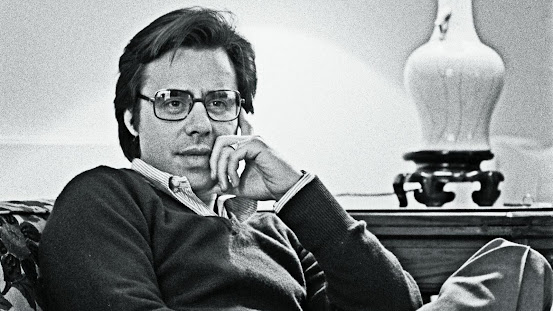
It Was Always Personal: A Brief Appreciation of Peter Bogdanovich


Last month, on January 6th, Peter Bogdanovich passed away. He was 82 years old, which is a nice long run, but it still seems like he was taken too soon. If you listen to almost any interview he gave over the last couple of years you'll hear him talk about the movies he still wanted to make, particularly a ghost story he wanted to film about a movie director haunted by his lost loves. 

One doesn't have to dig too deeply into that plot to find the spirit of Bogdanovich himself. He was among the most personal of filmmakers, not because his life details are reflected in most of the stories he filmed (his most famous film, for example, was about growing up in Texas, an experience far removed from the life experience of a New York kid like Bogdanovich). No, his movies were personal because of his experience of making them. Like his hero and sometimes-friend Orson Welles, Bogdanovich put his passion for filmmaking onscreen. The filmmakers who most revere Bogdanovich himself--Quentin Tarantino, Wes Anderson, Noah Baumbach--all resemble him in this respect: the passion for the medium is the de facto subject of their work. 

With Bogdanovich, of course, this stretched into his other job, that of film historian, writer, and critic. He didn't like being called a critic, and it's true that he only very occasionally functioned as one. He preferred the term "popularizer" which does seem more fitting. He rarely wrote, or even spoke on the record, about films or filmmakers he didn't like. He had a wealth of knowledge about old Hollywood, but his knowledge was idiosyncratic. He knew many of his favorite directors--Ford, Hawks, Renoir, Hitchcock, Ulmer--so he had opinions and stories about them to spare. But what about someone like Billy Wilder? Indisputably one of the great directors, Wilder and Bogdanovich had some bad blood back in the 70s, so there's barely a mention of him in any of the volumes of work Bogdanovich published on classic Hollywood. Likewise, Bogdanovich always had to be forced to say anything at all about any of his contemporaries (even ones like Francis Ford Coppola or William Friedkin with whom he had a short-lived production company). He wrote about what (and who) he liked, and pretty much ignored the rest. It was always personal with Peter Bogdanovich.

Likewise, his focus (obsession really) on directors and stars pretty much eclipsed his interest in any other area of filmmaking. Writers, cinematographers, art directors, producers (especially producers) get short shrift in his books and articles, and rarely got much mention when he was discussing his own films. The "Invisible Woman" season of the podcast YOU MUST REMEMBER THIS focusing on Bogdanovich's ex wife-and-collaborator Polly Platt is a nice corrective to the director-centric view of filmmaking that defined Bogdanovich's film histories and his interviews about his own films.

Having said all that, Bogdanovich was an auteur's auteur. The interviews he did with Welles in the book THIS IS ORSON WELLES is a primary text for any appreciation for Welles, and his interviews with classic directors in his book WHO THE HELL MADE IT? is invaluable. (One example, he conducted what might very well be the only surviving interview with DETOUR director Edgar G. Ulmer.) As a filmmaker, he was frequently brilliant, and always himself. His movies are stamped with his wit, his humanity, his passion for film, and his sensitivity to both love and the loss of love. 

I hope the next year or so will bring retrospectives of his work. We need PAPER MOON, WHAT'S UP DOC?, SAINT JACK, THE LAST PICTURE SHOW, and THEY ALL LAUGHED back in theaters. I'd love the chance to see something like AT LONG LAST LOVE on the big screen, and I've always had a warm place for his expertly wrought version of NOISES OFF. Bring it all back, you art house cinemas, and let us sit in the dark and enjoy the work of one of the greats.  

Thursday, July 25, 2019

OTHELLO (1952)


Orson Welles's adaptation of Shakespeare's OTHELLO is a film of unusual beauty. Even among the work of a visual master like Welles, it stands out. I don't want to linger on the incredible story of the film's production, which took place on two continents over three years and is a legend in its own right (Welles himself covered this territory in FILMING OTHELLO). Though it's worth noting the frantic, often desperate circumstances that Welles, his cast, and his crew, found themselves in, what matters is what was produced by those trials: this strange and beautiful film.

Before I go further, I need to say that I'm going to be writing here about the 1952 European version of the film rather than the 1955 US/UK version. Both versions were edited by Welles, so both stand as a "director's cut." It's fascinating to compare them, to see two different ideas Welles had for the film. In 1955, Welles redubbed the entire performance of Suzanne Cloutier (as Desdemona) with the voice of actress Gudrun Ure, as well redubbing about half of his own lines. He cut the spoken credits that had begun the film, clipped some dialog, and added some brief bits narration to set up the plot. 

For my money, the 1952 version is superior, and not just marginally so. The changes Welles made in 1955 produced a less compelling picture overall. His spoken credits in the '52 version allow for a much smoother transition between the tour de force opening funeral march and the beginning of the story proper. I've always considered the first dialog scene in the '55 version--where Iago and Rodrigo spy on Othello's wedding to Desemona--to be choppy and awkward. And Welles's narration in these opening scenes has always seemed to be an obvious patch, explaining things in the narration to cover over the confusing editing. In the 52 version, by contrast, the opening scenes get to breathe a little, and they play better without the expository, and largely unnecessary, narration. Welles also includes a line from the play that helps set up Iago's hatred of Othello ("It is thought abroad that 'twixt my sheets he has done my office") that was cut in the 1955 version.  

The larger change, of course, is the redubbing of Othello and Desdemona's dialog. There is, I will admit, a case to be made here for the '55 version. What Welles did in redubbing the dialog was to replace the elegant and meek Cloutier with the more forceful Ure. To match this Desdemona's new strength, he made his readings of Othello's dialog angrier and more macho. Some viewers will prefer this more "passionate" performance of the material.

But I think it worked better in 52. Cloutier's vocal performance of the material better matched her physical portrayal of Desdemona as a sweetly innocent girl. And Welles, in turn, responded to that portrayal by giving us an Othello that was a softer, sadder man driven crazy by jealousy. In '55, she's louder and he growls his lines more, but, in this case, less really was more.

One of the great joys of a Wellesian Shakespeare adaptation is Welles-the-screenwriter's lack of intimidation in the face of such a classic. He takes his scissors to the play and makes it work as a screenplay, clipping lines or rearranging them, sometimes just shaving off a word here and there, other times jettisoning whole speeches. If one wants to savor the Bard's original language, this is not the film to see.

Because what Welles does instead is to interpret the work as a piece of cinema, not just as a recorded performance of a play. Shot by shot, scene by scene, his visual compositions are a delight. Over the course of the production the director worked with five (!) cinematographers, but there can be no doubt that Welles himself was the eye behind the camera. From the opening funeral march, to the attempted assassination of Cassio in the Turkish bath, to the final scenes of Desdemona's murder and Othello's suicide, Welles creates rich, vivid images. Working in certain motifs throughout the film--prison bars and distorted mirrors--he varies angles on shots about as often as he cuts, giving the film a dynamic energy. And speaking of editing, scholars who have done the counting have calculated that OTHELLO has almost 2000 individual cuts, compared to 500 or so for CITIZEN KANE. While the cutting is a direct result of the circumstances Welles was working under, the film is unified by a vision. OTHELLO, after all, is a movie about the center not holding, about love and trust and friendship falling apart in a frenzy. And the movie itself reflects that idea visually.

Coultier is sweetly touching as Desdemona, but Welles is not a great Othello. Although his performance in the '52 version is superior to the '55, either way OTHELLO is a director's picture rather than an actor's picture.( This was true, also, of Welles's MACBETH a few years earlier. His Shakespearean triumph was, of course, FALSTAFF, a film that manages to be both an actor's picture AND a director's picture.) As both Macbeth and Othello, Welles is more declamatory than deeply felt, and his characterizations rarely go beyond a surface level reading of the roles. (Again, compare this to his more lived-in portrayal of Falstaff, the most moving performance he ever gave.)  

The one great performance in the film is given by Micheal Mac Liammoir, the legend of the Irish stage who had been a mentor to Welles when the actor was just starting out as a teenager. Mac Liammoir's performance is the one that lingers after the film is over. As Iago, he creates a delicious vision of wily evil, of internalized malice and outward cunning. He seduces everyone else in the film, and even when he's finally caught and imprisoned in a swinging cage to watch Othello's body carried off for burial, his secrets are still his own. 

Tuesday, May 7, 2019

FILMING OTHELLO (1978)


I think FILMING OTHELLO might be the greatest Orson Welles movie. Now, by that, I don't mean that it's the greatest movie made by Orson Welles. I mean that although the film purports to be about the making of Welles's 1952 adaptation of Shakespeare's OTHELLO, its true subject is Welles himself. It is a fascinating document of the man.

The film is one of the director's "essays," the most well known of which is the late masterpiece F IS FOR FAKE (1973), a meditation on art and authenticity. That film pursues a complex theme and arrives at a thesis (what one might call an anti-auteur theory of art). FILMING OTHELLO by contrast not only doesn't arrive at any conclusions, it doesn't really pursue a theme. (Welles himself acknowledges this late in the film, essentially saying that he didn't know where to focus.) We get some making-of stories told in the great raconteur style by Welles, some re-edited footage of OTHELLO itself (without the sound!), excerpts of a dinner conversation with two of his costars in the film (as well as his old mentors) Hilton Edwards and Micheal Mac Liammoir, footage from a Q&A with college students, and a couple of scenes of Welles sitting at his editing machine quoting speeches from the play.

Curiously, as a document about the filming of OTHELLO, FILMING OTHELLO is light on details and pointedly subjective in its perspective. It's a bit all over the place, not unlike OTHELLO itself. One can assume that this was intentional while also noting that it doesn't quite work. The scenes of Welles sitting and talking to the camera are entertaining, but they meander. Welles doesn't really articulate a reason for FILMING OTHELLO to exist. Why discuss this film, as opposed to any of his other films? More telling still is the odd fact that Welles--a lifelong student of Shakespeare and one of the bard's greatest 20th Century interpreters--doesn't really articulate a theory of the greatness of OTHELLO itself. Sure he sings the praises of the play, but he offers few insights into how and why it's great. 

The dinner with Edwards and Mac Liammoir is more entertaining than insightful (I would gladly watch hours of Micheal Mac Liammoir talking about anything...and for that matter I'd watch hours of him just listening to someone else talk, his eyes expanding like a peacock spreading his feathers every time someone says something he finds absurd). Though it must be said that the dinner scene does inadvertently offer one real insight because it displays just how binary Welles and his companions could be in their thinking about things like race and, especially, gender. Noting this about the film isn't a criticism of the film. This is a documentary, after all, and it documents three aging men (Welles, about 60 at the time, was the youngest) in the mid-1970s casually beginning their sentences with things like "A woman would never..."     

The dinner scene is also rather distracting because Welles has inserted new shots of himself asking questions and responding to comments from the other two men. I feel certain that some scholar out there has probably advanced the theory that this disjointed doesn't-quite-fit quality is some kind of meta-commentary by Welles on the disjointed making of OTHELLO itself. While I doubt that, and while it feels exactly like the kind of theory that Welles himself would mock, we should say that if Welles wanted the pieces of the dinner scene to fit together awkwardly then he succeeded to no apparent end.

The sequence with Welles talking to students is likewise entertaining, though it's probably worth noting how quickly the conversation moves on to something else (the making of MACBETH) without connecting back to the subject at hand. When one considers that this film is 84 minutes long and that the project came about when Welles was asked to record an introduction to OTHELLO for German television, FILMING OTHELLO takes on the hue of something that was fleshed out from a sketch and never found its proper form as a film. If you've read many interviews with Welles, this probably isn't surprising. As he made clear many times, he really didn't like talking about his work. As a result, FILMING OTHELLO ultimately doesn't have much to say about it either.  

I realize that much of what I've written so far has been critical of the film, which is odd considering that I said it might be the greatest Orson Welles film. But here's what I meant by that: because it lacks a true thesis about OTHELLO, this film keeps falling back on Welles himself as its defacto subject. The opening monologue of the film--with the director introducing the proceedings, singing Shakespeare's praises, claiming modesty in the shadow of that Great Man, and telling a couple of background stories--is vintage Orson Welles. Charming and witty, erudite and playful, it's Welles as showman, inviting us into the tent to see how the magic is made. These scenes (shot by Welles's longtime cinematographer Gary Graver in the mid seventies) capture a late-career Orson Welles in all his diminished glory and undiminished power. 

Toward the end, Welles delivers a couple of passages from OTHELLO while sitting at his editing machine. Again, there's no theory here. He doesn't deliver these speeches to illustrate a particular point about the character of Othello or the play or even his film (and since the scenes from the earlier film are shown without sound, these speeches are the only Shakespearean language that we get in the film). He just rather randomly starts reciting some lines. So why are they here? I think they're here because Welles wanted to record himself saying them. He's showing off. And he's great! It's impossible not to see the almost childlike joy the actor takes in sinking his teeth into that language. But the language itself isn't the point. Neither is Shakespeare. No, the point is Welles himself and the joy he takes in being an actor and filmmaker and raconteur. This would be the final film he would release in his lifetime, so it's fitting that it ends with him sitting at his editing machine in the dark, puffing on a cigar.   

As an essay about the movie OTHELLO, FILMING OTHELLO is intermittently interesting. As a unintentional portrait of Orson Welles at the end of his career, it's fascinating.     


Sunday, October 21, 2018

THE OTHER SIDE OF THE WIND: A Preliminary Report


It hardly seems possible that I'm about to write these words, but here I go. I just saw THE OTHER SIDE OF THE WIND. Like most Orson Welles fanatics of a certain age I've been waiting many years to see this movie. I first read about it in the early '90s, when it was more or less considered a long lost film. Gradually the narrative around it changed. Whispers were heard of heroic financiers who were going to swoop in and finally sort out all the tangled strings attached to the movie (i.e. someone with deep enough pockets was going to pay off all the people who had--or claimed to have--a piece of it). Then things would fall through. Finally, after decades--yes, decades--of effort by people like Frank Marshall, Peter Bogdanovich, and (most nobly) the film's late cinematographer Gary Graver something did happen. Netflix reached down into its big pockets and paid everyone off and bankrolled the post-production on the film. Now the film exists and will come to theaters and Netflix in early November.

I saw the film this afternoon at the Chicago International Film Festival. I'm still staggered by it.

Everyone will want to know if it's good or bad. That's how the average person appraises a movie, which is fair. The funny thing, of course, is that Welles rarely made movies that fit into easy categories. So to talk about, or really just to begin to talk about it, I should say a couple of things. One, Orson Welles died before he could finish editing this film. (Since he died almost ten years after wrapping principal photography, that should tell you something about the pace of his editing and the tortured circumstances of his film-making process in the 70s and 80s.) So, beware anyone who talks about this movie without first acknowledging that it is not simply a recovered Orson Welles film. It is a film written and directed by Orson Welles but completed by other people. That's important. Welles did not have, as if were, final cut of this movie. This in no way denigrates the admirable efforts of the people who finished the film, it's simply to acknowledge the reality. The other thing to say is that THE OTHER SIDE OF THE WIND is a 70s art film. I wonder what the Netflix audiences will think of it. I frankly doubt that most people who start it on Netflix will finish watching it.

The film tells the story of the last day in the life of a film director named Jake Hannaford (John Huston). He's surrounded by sycophants, cinephiles, disciples, yes-men, skeptical reporters, would-be starlets and pissed off producers. 

The action swirls. I use that word advisedly because THE OTHER SIDE OF THE WIND is the culmination of the whirlpooling mise en scene that Welles honed in films like THE LADY FROM SHANGHAI and THE TRIAL (you see it, in fact, in practically all his films). Characters are always in motion, constantly circling each other as they fire off dialog. This whirlpool movement is married with the rapid-cut editing Welles planned (but, again, never fully achieved) for the film. The result is a propulsive experience.

I want time to process the film, and I'll certainly see it again when it's released in theaters next month. So here's just a few preliminary notes:

1. The film marks the largely unexplored intersection of Orson Welles and 1970s pornography. There's softcore porn vibe to the opening scenes of the film and to the scenes of the film-within-the- film (Hannaford has directed an out of control "arty film" that's mostly notable for being full of sex and nudity). Welles's cinematographer and right-hand man for the last 15 years or so of his career was Gary Graver, a part-time porn director, and we know that in the 70s Welles helped Graver edit at least one hardcore porno (1975's 3A.M.). THE OTHER SIDE OF THE WIND'S interest in sex is part of Welles's expanding sexual interest--at least onscreen--in the 70s. I think we owe this to his partner in life and art, Oja Kodar. The film was cowritten by Kodar, and she's clearly the muse at the center of it. Welles's camera never worshiped a woman like it worships Oja Kodar.

2. Yet the film is largely a dissection of the male ego in all its misogyny, bigotry, and repressed homosexuality-turned-homophobia. It's almost shocking how acidic Welles's take on the main character is, given that he knew Huston's character would be seen as a stand in for himself. He would have fought back against that interpretation, I imagine, but there's too much of Orson in the character to ignore, from his relationship to a Peter Bogdanovich-type character played by, of course, Peter Bogdanovich, to little phrases (like "Always remember that your heart is God's little garden") that Welles himself was fond of.

3. Neither of the actors in the film within the film, Oja Kodar and Robert Ransom, speak a single word. They remain objects--unattainable, sexualized objects--for the director. It is implied that Hannaford kills himself because he cannot have the Ransom character. I suspect that this would have been edgier stuff in 1970 when Welles began working on the picture. I want to see THE OTHER SIDE OF THE WIND again in part because I'm interested to know if Welles is saying anything beyond that. In terms of sex, I'm not sure that he is.

4. But what a film "is saying" is always a pretty nebulous thing, and often a wholly unimportant thing. No one knew that better than Orson Welles. It was Welles, after all, who would tell anyone who asked that "Rosebud" was a cheap trick, a way to tie up the end of CITIZEN KANE. Welles knew better than most that what mattered was the film itself, not the filmmaker, and certainly not the filmmaker's "message."

5. Which brings me to the point that, yes, I'm happy to report that THE OTHER SIDE OF THE WIND  is a good movie. It's stylistically fascinating and often quite funny, with some good performances from Huston and Bogdanovich, and a stand out performance from the underrated director Norman Foster as Hannaford's flunky, Billy. The fact that Foster was often unfairly maligned because of his association with Welles is just one of many, many ways the film overlaps with real life, commenting on it, satirizing it (often perversely), and lamenting it.

Friday, October 27, 2017

Orson Welles On The Air


Between the period that he became a groundbreaking theater director and the period when he became a groundbreaking film director, Orson Welles was a groundbreaking radio director. Actually, these periods all overlapped in the mad days of the 1930s when Welles seemed to be everywhere, doing just about everything. His film work has, of course, seized the attention of the most people, if for no other reason than it is the work that's been most readily available to the public. His theater works, as all theater works, live on mostly in reports and stories and legends. (God, I'm pining for someone to put out a new exhaustive exploration of his theater work spanning from the 30s to the 60s.) For those interested in his radio work, however, there is wonderful news from Indiana University.

The Lily Library in Bloomington, the guardian of the largest collection of Welles's papers and archival materials, has a magnificent new resource available to the public.

Orson Welles On The Air collects much of Welles's prolific radio work as a director, actor, political commentator, and master of ceremonies. Included are the series' FIRST PERSON SINGULAR, MERCURY THEATER ON THE AIR, CAMPBELL PLAYHOUSE, THE ORSON WELLES SHOW, HELLO AMERICANS, ORSON WELLES COMMENTARIES, and more. Much more. It's fascinating to see Welles alternate between his roles as an entertainer (mounting a thrilling version of "Dracula" or his famous panic-inducing take on "War of the Worlds") to his work as a social critic (including his five episode campaign on ORSON WELLES COMMENTARIES calling for an investigation into the 1945 beating and blinding of an African American serviceman named Issac Woodard in South Carolina). 

Welles is back on the air where he belongs. Go check it out.


Saturday, December 31, 2016

My Year at the Movies: 2016


I go to the movies a lot. I started this blog about eight years ago because I wanted to have a place to think out loud about the movies I was seeing--to reflect on the old and the new, on the good and the bad. I called it the Night Editor because I tend to write late and because I like the 1946 noir NIGHT EDITOR  directed by Henry Levin and starring Janis Carter (an overlooked minor gem, btw). A lot has happened for me in years since I started the blog. I've published several books, been to France twice on book tours, participated in several readings at Noir At The Bar functions, and relocated to Chicago. 

But I've also seen a lot of movies. On the side of this blog I keep a running tally of how many movies I've seen at the theater. I don't know why I do this, except that going to the movies is the closest thing I have to a hobby.

This year I saw 85 movies at the theater. That's a lot, I know, (a movie about every four days), but the true measure of my cinephilic tendencies is that I don't feel like I saw enough. I still managed to miss so many interesting-looking new films and great old classics in rerelease.

I'm not someone who generally laments the state of film. Yes, schlock too often rules the box office. Yes, I worry about the reheated nature of our choices, where it seems that almost everything at the box office is a do-over of some pre-existing property. Yes, the culture is ever more infantilized. Yes, it is harder and harder to get movies made for adults.

And yet...

In some ways, things are better than we give them credit for being (and things in previous days were often worse than we give them credit for being). Here's a list of some good things about the current state of movies.

1. Hollywood has perfected the comic book movie and the sci-fi popcorn movie. A case in point: this year I saw DOCTOR STRANGE. Here's a movie that could only exist at this particular moment, the result of Marvel's mastery of the comic book movie. It has a great cast of capable actors slumming it in a labyrinth of good special effects and efficient storytelling, and the result was an entertaining afternoon at the movies. When they make the inevitable sequel, I'll check it out. Of course, I'm not saying that the Hollywood machine always gets it right. CAPTAIN AMERICA: CIVIL WAR was fun but overstuffed while BATMAN V SUPERMAN: DAWN OF JUSTICE was stupid and sluggish, just to take two high profile examples. But overall I think Hollywood is doing this stuff as well as it can be done. The comic book movie is the modern equivalent of the old time spectacular. Will we look back and call DOCTOR STRANGE a masterpiece? Probably not, but I really do think it will hold up better than AROUND THE WORLD IN 80 DAYS (1956) and that piece of shit won Best Picture...

2. Great stuff still gets made. This year I saw films as different as MOONLIGHT, MANCHESTER BY THE SEA, HAIL CAESAR!, ARRIVAL, CERTAIN WOMEN, and FENCES. If I'd only seen these movies, I still would have been pretty happy at the breadth and accomplishment of the year. Different movies with different tones and intentions, but so much skill and heart.

3. The revival business is going strong. I have to start here by saying that "strong" is a relative term. I'm not trying to suggest that it's 1960s-film-society strong out there, but, when it comes to classic film, I had an incredible year at the movies. Just to name a few: I saw the triumphant restoration of Welles's masterpiece CHIMES AT MIDNIGHT (twice), as well as Bergman's THE SEVENTH SEAL, the Coens' BLOOD SIMPLE and BARTON FINK, Ozu's LATE AUTUMN, Kurosawa's YOJIMBO, von Stroheim's GREED, and Hitchcock's VERTIGO. The movie event of the year for me was the release of Kieslowski's DEKALOG, the ten hours of which comprised my most exciting cinematic experience this year.

I should say a few words about disappointments. In the realm of blockbusters, I think the Star Trek and Bourne franchises are in trouble. STAR TREK BEYOND was more entertaining than its horrible trailer, but the series itself is adrift. And JASON BOURNE feels every bit like a movie that knows it has no reason to exist. On the art side, Terrence Malick was back with KNIGHT OF CUPS, the kind of meandering pose-striking mess someone might make to parody Terrence Malick.

Here's my top ten new releases of the year, in no particular order:

1. MOONLIGHT-A triumph from director/screenwriter Barry Jenkins, this coming of age tale might be the most perfectly achieved new film I saw this year, with vivid camerawork and brilliant acting. Unfolding in three chapters over several years, it creates and maintains an atmosphere of emotional intensity without ever seeming to reach too hard for effect. Devastating and beautiful.  
2. MANCHESTER BY THE SEA-No film I saw this year haunted me as much as this one. Director/screenwriter Kenneth Longeran tells a quietly funny and finely observed story about the ways we live with grief. Casey Affleck is a slow burning flame in the lead role as an emotionally isolated janitor dealing with the death of his older brother, and as his ex-wife Michelle Williams proves once again that she's one of the best actors working. 
3. HAIL, CAESAR!-This movie divided a lot of people, even admirers of the Coen Brothers. All I can say is that it feels like a movie they made just for me, a whacked out comedy about the Hollywood studio system, with singing cowboys, dancing Communists, Jesus-obsessed studio fixers, and a goofball star of biblical epics played by George Clooney in his best comic turn in years.
4. FENCES-A world where Denzel Washington makes adaptations of August Wilson plays is a fine world, indeed. He and Viola Davis do a powerful duet here as a married couple confronting themselves, and each other, for the first time. With exceptional supporting work from Stephen Henderson and Jovan Adepo. There's talk of Washington producing more plays from Wilson's Century Cycle, which goes on the short list of things to be excited about. 
5. CERTAIN WOMEN-An anthology film from director/screenwriter Kelly Reichardt based on the stories of Maile Meloy tells three different tales set in Montana. The first two stories are interesting, but the third story, about the would-be romance between a shy ranch hand (Lily Gladstone) and a young lawyer (Kristen Stewart), is a delicate heartbreaker, among the finest things that Reichardt has done. 
6. ARRIVAL-This was the best sci-fi movie of the year. Sure ROGUE ONE was okay, but in a better world this deeply involving and strikingly achieved film from director Denis Villeneuve would be the one breaking records at the box office.
7. MIDNIGHT SPECIAL-Director/screenwriter Jeff Nichols makes such wonderfully quirky and specific films. This is his most daring to date, a religiously infused bit of sci-fi realism with yet another powerhouse performance from Michael Shannon.
8. WIENER-DOG-Director/screenwriter Todd Solondz is not usually my cup of cinematic tea, but this brutally funny pitch-black comedy hit me where I live. It's grim, unflinching, and hilarious.
9. LA LA LAND-From director/screenwriter Damien Chazelle and composer Justin Hurwitz, this musical comedy is a hell of a lot of fun. Some unfocused storytelling in the middle sections and some vocals-too-low-in-the-mix keep it from being completely successful, but it's carried along by good music and a stellar performance by Emma Stone.
10. NOCTURNAL ANIMALS-The final third of this twisty drama from director/screenwriter Tom Ford (adapting the novel TONY AND SUSAN by Austin Wright) has elements of a conventional (and lesser) thriller, but such is the power of this piece that I don't know what to make of them. I need to see this movie again to unravel the threads of reality and unreality that tie together its main storyline (an art dealer played by Amy Adams is shown a new novel written by her ex-husband) and the story of the novel in which a family man played by Jake Gyllenhaal (who also plays the author of the novel) seeks to avenge the murder of his wife and daughter with the help of a dying detective played by Michael Shannon (in his other great performance of the year).

Other good films I saw this year included the riveting documentary WEINER, the coolly unsettling THE LOBSTER, the effective Blake Lively-versus-Jaws thriller THE SHALLOWS, the fun GHOSTBUSTERS reboot, the happily trashy THE NICE GUYS, the well-acted rural noir HELL OR HIGH WATER and the quirky western IN A VALLEY OF VIOLENCE featuring a wonderful scene-stealing performance from John Travolta as the morally conflicted, and often laugh out loud funny, bad guy.

In addition to those already mentioned, some of the best revival movie experiences I had this year included seeing my beloved PAPER MOON (1973) on the big screen for the first time; discovering Stephanie Rothman's deeply subversive THE STUDENT NURSES (1970) and Peter Fonda's trippy THE HIRED HAND (1971); and revisiting Billy Wilder's hilarious ONE, TWO, THREE (1961), Bogart's final film THE HARDER THEY FALL (1957) and Scorsese's masterpiece TAXI DRIVER (1976). My best discovery at the revival movies was the Nicholas Ray rodeo drama THE LUSTY MEN (1952) which features the best Robert Mitchum performance that most people haven't seen.

All in all, it was a damn good year at the movies. The year ahead looks foreboding in many ways for our politics and our society. We need the movies more than ever, and here's hoping 2017 will find me (and you) in the dark, staring up at the big screen.

Sunday, May 15, 2016

WARNING SHADOWS: HOME ALONE WITH CLASSIC CINEMA by Gary Giddins


I love a good collection of film essays. In particular, I like to curl up with the work of a single author, watching one mind as it travels through disparate works or genres or eras. As a kid, I was a Roger Ebert fanatic. I used to buy his huge Movie Annuals every year. (My mother: "Another one? Didn't you get one last year?" Me: "You don't understand.") As I got older, I discovered Pauline Kael and Peter Bogdanovich and Eddie Muller, revelations all.

My latest favorite is Gary Giddins' 2010 collection WARNING SHADOWS: HOME ALONE WITH CLASSIC CINEMA. The book has a brilliantly simple conceit. Giddins begins with an introduction that traces the development of cinema from the solitary experience of the earliest Edison nickelodeons to the Golden Age movie palaces to post-studio era multiplexes to the rise of home video and the DVD revolution. He stops just short of the latest earthquake in cinema distribution and exhibition, the era of digital streaming.

I'm glad that he stops at that point, because it allows the book that follows to focus almost exclusively on the act of watching classic cinema on DVD. As much as I think about film, I have to admit that I've never given much thought to the fact that I've seen more classics on DVD than any other format. Giddins--writing for outlets like The New York Sun, DGA Quarterly, and the Criterion Collection--is examining the films within their current context, as part of DVD packages like the Warner Bros. Signature Series which collects the work of a star like James Stewart or the Criterion Collection which assembles packages like THE COMPLETE MR. ARKADIN by Orson Welles. It's fascinating to consider these films not just as works of classic cinema (as if we were beaming ourselves into the past to watch them as part of a double feature at some long lost movie temple) but as works that exist largely as solitary home entertainments. Giddins has a particular insight into the way that this new context has affected the delicate charms of classic comedy. Chaplin and Keaton created movies to be seen by hundreds of people crammed together in the dark, their laughter a communal event. How haunting it is to see them play out in the relative silence of your living room.

The book itself covers a wide range of topics--from great directors (Welles, Hitchcock, Ford, Bergman, ect.) to great stars (Crawford, Davis, Bogart, ect) to genres like the biopic, the musical, and the film noir. Giddins is a deft and daring guide down these well traveled roads. At a certain point, a reader needs a writer to reject the conventional views of artists and works. The way Giddins reframes something like the career of Alice Faye made me want to revisit her work. 

And really a reader couldn't ask for more from a collection of writing on film. Giddins writes about movies that are sixty, seventy, eighty years old and makes them fresh candidates for tonight's movie viewing.

Sunday, May 1, 2016

ORSON WELLES VOLUME 3: ONE-MAN BAND by Simon Callow


This week I finished the third installment in Simon Callow's projected four volume biography of Orson Welles. If four books on one life seems like a lot, consider the life we're talking about. No matter what one thinks about Welles or his work, one has to concede the point that the man packed a hell of a lot of living into his brief 70 years on earth.

Just consider this: Callow's new book covers the years 1948 to 1965. In that time, Welles worked on three continents (North America, Europe, and Africa), made five movies--three of which are masterpieces (TOUCH OF EVIL, THE TRIAL, FALSTAFF), mounted seven stage productions--two of which (MOBY DICK REHEARSED and CHIMES AT MIDNIGHT) are considered among the best work he did in the theater, and created five television productions--two of which (THE FOUNTAIN OF YOUTH and AROUND THE WORLD WITH ORSON WELLES) are thrilling experiments in the new medium. During this time he won the Palm d'Or (for his film of OTHELLO), the Peabody Award (for THE FOUNTAIN OF YOUTH) and the Best Actor award at Cannes for his performance in the movie COMPULSION. During this time he became the hero of critics and directors of the French New Wave, the living embodiment of the film director as artist. 

It was also during this period, unfortunately, that he became enshrined in America as a big fat has-been. One of the reasons Welles makes for an endlessly fascinating biographical figure is that his triumphs were often greeted as failures and his artistic prime was regarded by many at the time as a self-destructive freefall.

The disjunction between Welles's artistic accomplishments and his professional woes is covered thoroughly by Callow in ONE-MAN BAND. Callow is a critical biographer, and one can feel his exasperation at some of Welles's more self-defeating behavior. Yet he never loses sight of the man. For instance, I've read a couple dozen books on Welles, but I don't think I've ever read anyone who better captured Welles's insecurity around the topic of acting. Perhaps because Callow is an actor himself, he is particularly well-attuned to Welles's fear of performance. We think of Orson Welles as being almost supernaturally confident and self-possessed, but as Callow makes clear he fretted his time upon the stage as much as any actor ever did.

Every biography about Welles has to contend with one core question: Was he a self-destructive failure or a misunderstood genius? Callow avoids an easy answer, but taken in whole this book's answer to that question would be "Both."

Welles was his own worst enemy, a "prisoner of his own personality" as Callow once put it in an interview. He worked in art forms like film and theater that require a lot of capital, yet he loathed the money men and found it impossible to kowtow to them. He was a tireless worker, but no one ever accused him of self-discipline. He was always open to inspiration, but that same openness could mean that his attention was fickle. His list of credits is beyond impressive, it's staggering; yet that same prodigious output was often seen by unsympathetic observers as flailing.

Indeed, one thing that Callow's tour through these years makes clear is the way that Welles's triumphs must have all seemed fleeting to the man himself. His greatest accomplishment of this period (and perhaps the greatest accomplishment of his career) was FALSTAFF. It's his masterpiece, but in America it was dismissed out of hand. Welles, Callow reports, was nearly driven to despair by this failure, a failure that came in the wake of the failure of the brilliant TOUCH OF EVIL to rekindle his Hollywood career.

Still, Callow ends this volume on the triumph itself. Welles once said that FALSTAFF was the film he would offer up if he were told that one of his films might get him accepted into paradise. Callow ends his book by reporting that the movie "proved not to be a harbinger of anything; Welles sailed off in other directions. But not before he had secured his place in heaven."

Friday, January 15, 2016

YOUNG ORSON


I guess I'm obsessed with Orson Welles. I was on the fence about this--the question of "Am I obsessed? Or am I just a huge fan?"--until recently. I mean, Welles has long been one of my favorite directors. I own all his movies. I own multiple copies, in fact, of most of his movies. I've seen all his movies on the big screen, and I've seen most of them more than once. So, sure, I'm a huge fan.

But I realized I was obsessed when I recently took a step back from my bookshelf and realized that I've read over two dozen books about the man and his films. That's more books than I've read about any other human being. I realized I was obsessed because, despite this bulk of reading, I always want to read more.

I also realized I'm obsessed because when I finished Patrick McGilligan's brilliant new biography YOUNG ORSON, I wanted nothing more than to pick up another book on the guy.

Of course, some of this is due to the quality of McGilligan's book itself. YOUNG ORSON is the best biography of Welles that I've ever read. It's beautifully written and deeply researched. At this stage of our understanding of Welles and his work, it's also a decisive argument against the longstanding theory that Welles was just a self-destructive boy genius whose late-career hardships were, like his obesity, the result of a deep-seated character flaw.

That theory hammered Welles in his later years and infected much of the discussion of his work for years, even decades after his death. It was promoted by people like Pauline Kael in her famous essay "Raising Kane" which portrayed Welles as a washed-up overrated credit-stealing egoist. It was promulgated by John Houseman, Welles's former friend and associate, in various books and interviews. Most dispiritingly, it was enshrined by the documentary THE BATTLE OVER CITIZEN KANE, which won an Oscar and was included in the official anniversary packages of CITIZEN KANE on DVD and Blu-Ray.

Despite all of that, many cinephiles have long known better. (I wrote about this years ago, around the time of the release of Richard Linklater's ME AND ORSON WELLES.) Most importantly, the myth of Welles's self-destruction never took into account his actual post-KANE film work--from his noirs THE LADY FROM SHANGHAI and THE STRANGER and, especially, TOUCH OF EVIL to his brilliant literary adaptations like THE TRIAL (which is the Welles film I return to the most), THE IMMORTAL STORY, and, of course, his glorious Shakespeare masterpiece FALSTAFF. No one who has contended with those works (most of which were little seen in the United States) could believe that Welles was a one-hit wonder.

Several books have helped to restore Welles to his rightful place in film history. Editor Jonathan Rosenbaum's THIS IS ORSON WELLES, the interview book between Welles and Peter Bogdanovich, is a masterpiece that remains the most important book to date on the man and his work. And ORSON WELLES AT WORK by scholars Jean-Pierre Berthomè and François Thomas did more than any other book to show us how Welles actually made his films. 

With YOUNG ORSON, McGilligan thoroughly debunks the myth of Welles as an ego monster who tore through people in a ruthless quest for power that ultimately destroyed him. The Welles who emerges here is fully human--capable of cruelty but also of great generosity, a man willing to work harder than anyone, a man willing to spend all his time and money and energy on his art. Did he have large appetites for food and booze and sex? Yes, but McGilligan does a nice job of bringing the myth down to size via some rigorous fact-checking. To take one example, he shows how John Houseman would tell a damning story about Welles gallivanting around with a ballerina at some particularly inopportune time...despite the fact that the woman in question was in a different place in the company of her husband.

In many ways, Houseman emerges, if not the villain of the book, then at least as the antagonist. This is a much needed corrective to all the books that unquestionably accept Houseman's word as the disinterested recollections of an old associate. Instead, McGilligan shows Welles and Houseman as temperamentally opposed men whose falling out was something along the lines of a bitter divorce. Houseman spent much of the rest his life conflating facts, spreading gossip as gospel and telling stories that portrayed Welles in the worst light possible. All of this is important to understand since Houseman was the primary source for people like Pauline Kael and Charles Higham, the author of a damaging biography on Welles.

I've only scratched the surface of this book. Among other things, it provides the most detailed portraits yet of Welles's parents, especially his fascinating mother, the crusading suffragist Beatrice Welles. After the deaths of his parents, it charts his course through Todd's School for Boys in Woodstock, Illinois to his sojourn at the age of sixteen to Ireland where he supported himself by writing pulp fiction, painting, and finally becoming an actor in Dublin. From there the accomplishments mount--writing a textbook on Shakespeare while traveling to Spain where he became obsessed with bullfighting before his return to America where he worked as an actor before becoming the most important stage director of his time and then becoming the most infamous radio director in the world before then traveling to Hollywood to make the most influential movie of the last seventy-five years.

So yes, I'm obsessed, but how could you not want to know more about that guy. Welles lived an absolutely fascinating life from beginning to end, and Patrick McGilligan has charted the incredible first leg of that life's journey in beautiful detail.

Monday, January 4, 2016

My 2015 At The Movies


I went to the movies 61 times in 2015. That's about my average, and it's better than a movie a week, which makes me happy. I saw two movies (MAD MAX: FURY ROAD and SPOTLIGHT) twice, so I saw a total of 59 films. 30 of the films were released in 2015, while the other 29 were older films. The first movie I saw was PREDESTINATION (2015) and the last I saw was CAROL (2015). The oldest movie I saw was DW Griffith's WAY DOWN EAST (1920).

2015 was the centennial of Orson Welles, so I got to see a lot of Welles films in the theater, the mark of any good moviegoing year. Of course, that included favorites like CITIZEN KANE and FALSTAFF (CHIMES AT MIDNIGHT) that I've seen in the theater many times, but it also included THE IMMORTAL STORY, which I'd never seen in a theater before. Now that was a damn highlight. (Sadly, I didn't get to see THE TRIAL.)

My biggest find of the year was to rediscover the grace and beauty of Satyajit Ray's APU TRILOGY. I first saw Ray's films in my early twenties when I was consuming as much classic cinema as I could. I discovered a lot of lasting loves that way (Ulmer, Bergman, Kieslowski), but some things fell through the cracks. I liked Ray's films, but perhaps I was too young, too immature for them back then. Whatever the reason, I discovered them anew this year when APU was rereleased in theaters. Deeply moving and beautifully made, they instantly became films that I treasure and am eager to return to as soon as possible.

Of course, man does not live on classic film alone. I had a great year with the new stuff. I loved SPOTLIGHT, a smart and tightly controlled piece of outrage. MAD MAX: FURY ROAD was the best action film I've seen in years. I really do think it's some kind of crazy masterpiece.

I think I saved the best for last, because the final film I saw this year was CAROL, the romance directed by Todd Haynes and written by Phyllis Nagy. Set in the fifties, the film is based on the 1950 novel THE PRICE OF SALT by Patricia Highsmith, and stars Cate Blanchett as a married woman who meets and falls in love with a shopgirl played by Rooney Mara. Haynes, one of our best directors, is a classical filmmaker whose devilish streak compels him to keep making movies like FAR FROM HEAVEN or the mini-series MILDRED PIERCE that rescue genre pieces from the past and reinterpret them for modern audiences. With CAROL he's made perhaps his best film, taking the kind of story that was once dismissed as lesbian pulp. As with MILDRED PIERCE, though, a big part of what Haynes and screenwriter Nagy do here is to simply respect the integrity of the original material. The result is an instant classic.

All in all, it was a great year at the movies. Here's what I saw:

1. Predestination (2015)

2. Selma (2014)

3. Jupiter Ascending (2015)

4. A Girl Walks Homes Alone At Night (2015)

5. Hogtown (2015)

6. She's Beautiful When She's Angry (2015)

7. 7th Heaven (1927)

8. Mildred Pierce (1945)

9. The Woman On The Beach (1947)

10. The Duke of Burgundy (2015)

11. Avengers: Age of Ultron (2015)

12. Magician: The Life and Career of Orson Welles (2015)

13. Falstaff, or Chimes At Midnight (1965)

14. Mad Max: Fury Road (2015)

15. A Woman's Secret (1949)

16. Mad Max: Fury Road (2015) 2nd time

17. The Immortal Story (1968)

18. Magnificent Obsession (1954)

19. Un Chien Andalou (1929)

20. Othello (1952)

21. The Set-Up (1949)

22. Pather Panchali (1955)

23. Citizen Kane (1941)

24. Aparajito (1956)

25. Apur Sansar (1959)

26. The Magnificent Ambersons (1942)

27. Touch of Evil (1958)

28. The Birds (1963)

29. Spy (2015)

30. Way Down East (1920)

31. The Third Man (1949)

32. Ant-Man (2015)

33. Inside Out (2015)

34. Trainwreck (2015)

35. Falstaff, or Chimes At Midnight (1965)

36. Black Magic (1949)

37. Mission: Impossible--Rouge Nation (2015)

38. Amy (2015)

39. Dark Places (2015)

40. Pushover (1954)

41. Takin' Place (2015)

42. Woman On The Run (1949)

43. Hangover Square (1945)

44. Ladies In Retirement (1941)

45. Queen Of Earth (2015)

46. Coming Home (2015)

47. Phoenix (2015)

48. Goodnight Mommy (2015)

49. The Martian (2015)

50. The First Legion (1951)

51. The Walk (2015)

52. Her Sister's Secret (1946)

53. Spectre (2015)

54. Faster, Pussycat! Kill! Kill! (1965)

55. Victoria (2015)

56. Spotlight (2015)

57. Spotlight (2015) 2nd time

58. The Killing (1956)

59. In The Heart Of The Sea (2015)

60. Star Wars: The Force Awakens (2015)

61. Carol (2015)

Sunday, December 6, 2015

Leopold And Loeb


Tonight, I got to catch John Logan's play NEVER THE SINNER on its closing night at Victory Gardens Theater (aka The Biograph Theater). The show was enjoyable, with a talented cast and energetic staging by Gary Griffin, and it sent me once more down the rabbit hole that is the Leopold and Loeb case.

I thought I'd post a link to my Criminal Element piece on the case from back in 2012, Leopold and Loeb Still Fascinate After 90 Years. I feel like a viewing of Richard Fleischer's 1959noir COMPULSION is right around the corner for me...

Thursday, June 11, 2015

Orson Welles at 100: F FOR FAKE


How do we even begin to address the uniqueness of F FOR FAKE? In the final entry in my series on Orson Welles at 100 over at Criminal Element, I give it a try.

Check it out here.