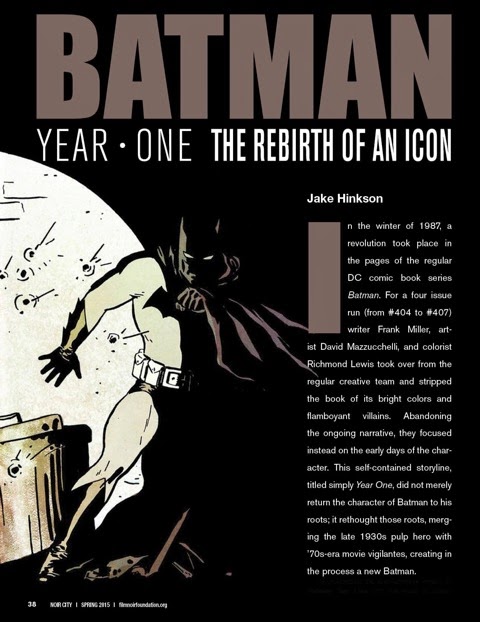
The new issue of Noir City is here, and it is a beauty. Great contributions from Steve Kronenberg, Imogen Sara Smith, and Eddie Muller--and some really standout work from art director and designer Michael Kronenberg. The focus of the issue is comix and noir, and features a big interview with Ed Brubaker and Sean Phillips, the team behind the brilliant series THE FADE-OUT.
The book also features a couple of articles by yours truly: first up, a piece on BATMAN: YEAR ONE which might be the most noir Batman story ever.
My other article is the newest installment in my series on Poverty Row Professionals: a career overview of director W. Lee Wilder. Wilder was the older brother of Billy Wilder, and he's been overlooked for years, but he's a really fascinating figure. He stayed an independent on Poverty Row his entire career, and while his films are bargain budget productions, they have a theme so unified that it counts as an obsession: the predatory older man who stalks an impressionable young woman.
Check out Noir City Spring Issue 2015.
My new piece on the director Edward L. Cahn appears in the Winter Issue of NOIR CITY. It's the newest entry in my series on Poverty Row Professionals, and Cahn certainly fits the description. He was the kind of workman who cranked out picture after picture at studios all over Hollywood--though the bulk of his work was produced at small outfits that operated on shoestring budgets. Despite these constraints, his work was always interesting and he made some notable additions to film noir.
I'm in the middle of working on the next entry in my Poverty Row Professionals series for Noir City magazine. I'm going to be profiling the director Edward L. Cahn. As such, I've been watching a lot of his work, and not just the noir stuff either.
I just watched his 1961 western GUN STREET. This is a modest film with a small cast, limited sets, and little in the way of a budget.
The film isn't claimed by anyone (least of all me) as some kind of hidden masterpiece, but within the context of when and how it was made, it's quite an interesting movie.
It's something of a knockoff of HIGH NOON, though like RIO BRAVO, it is critical of that film's subversive message. HIGH NOON is essentially an extended meditation on the fickleness of society and the fragility of the institutions that are meant to keep it together. GUN STREET, like RIO BRAVO before it, is not.
GUN STREET has a heroic lawman (played in an effective turn by Cahn's frequent leading man, James Brown) waiting for the imminent arrival of a deadly outlaw. The town panics as the outlaw nears. The lawman stands strong.
That's the basic plot, but in more ways than one GUN STREET fails to deliver what the usual oater would promise from this scenario. We never see the outlaw. Never. Some critics of the film have argued that this dissipates the tension, but I would argue otherwise. Most normal westerns would hop back and forth between the hero and the villain, would give us someone to hate. Instead, here, the approaching trouble feels more like a storm than a man. The townspeople bicker over why the outlaw wasn't executed to begin with. (The movie could be read as a 67 minute argument in favor of the death penalty.) But at the end the outlaw is found dead, having bled to death from a gunshot wound he suffered while escaping. Thus, the villain we never see is killed by some guard we never even hear about. Everything in the film has led up to a climactic gun fight that we never get. It's as if Frank Miller had missed the train in HIGH NOON.
Again, many critics of the film see this as a simple oversight, but I somehow doubt that. Edward Cahn made roughly a million westerns. He knew all too well that the audience was expecting to see the hero kill the villain at the end, and I find it hard to believe that either he or his writer Sam Freedle (who had been a script clerk on HIGH NOON) simply forgot the gunfight at the end. I doubt they ran out of time or money either. The final scenes of the film, involving the discovery of the body of the outlaw and the retirement of the lawman (he rides away through a posse scattered over the side of a mountain) would have been as complicated as a simple two-man gun fight.
I think Cahn just wanted to do something different.
I'm doing a series on the professionals of classic Hollywood's Poverty Row for the e-mag Noir City. My first installment was on the career of the underrated John Reinhardt (THE GUILTY, OPEN SECRET).
My latest piece is on William Castle. He's best known today for the flamboyant gimmicks he used to sell his schlock horror movies in the fifties and sixties, but in the forties he'd down a lot of work on Poverty Row and in the B-units of some larger studios. He gave us one of the first film noirs in the class of 1944 (WHEN STRANGERS MARRY), apprenticed under Orson Welles on THE LADY FROM SHANGHAI, and produced several other good examples of noir before moving on to fame and fortune as a self-crown master of the macabre.
You can check out my article on Castle by getting Noir City.