Saturday, June 26, 2010

A Cold Night in Murder CIty


If you like your summer reading cold and bleak (and I know you do), then there's some good news today. In the just released issue of Crimefactory, I have a new story that's a nasty slice of noir, a tale morally compromised officers of the law up to no good. It begins:

He said he needed to talk. I had to go outside for a cigarette break anyway, so we walked downstairs. Wet snow flurries pelted the sidewalks, and all the smokers wedged into a space just beside the front door to keep out of the wind. Graham motioned me away from the smoker’s nook, though. What he had to say was private. He didn’t want to say it around a bunch of cops.

I'm thrilled to be in this issue alongside some fine writers: Eric Beetner, Naomi Johnson, Jason Duke, and Pulp Serenade's own Cullen Gallagher. Crimefactory 3.5, available online and on Kindle. Check it out and let me know what you think.

Sunday, June 20, 2010

The Killer Cometh


Michael Winterbottom's adaptation of Jim Thompson's The Killer Inside Me opened in limited release on Friday. It hits DC on July 2nd, but the controversy surrounding the film has already preceded it like a bad reputation.

I've been waiting for this film for over a year now, though honestly, at this point, I'm a little nervous to see it. I'm braced for a disturbing experience, and I remain hopeful that the film is a good disturbing experience--but I'm also open to the idea that the film is cynical trash disguised as art. Only a viewing of the film itself will provide an answer.

Until then, here are some interesting links.

First up, an overview of the long march from novel to screen. A film version was proposed a long time ago with two huge--and somewhat surprising--stars. Why did that adaptation fall through? And how do you now get people to commit to making a film this damn dark in an age of 3D blockbusters?

Second, "Filmed to a Pulp" is a wider look at the challenges of adapting Thompson for the big screen. This one is by Charles McGrath of the New York Times and is thankfully more interested in the film and its source than in the controversy surrounding it.

Lastly, here's an interview with Casey Affleck, the star of the film. No matter what comes of The Killer Inside Me, I think Affleck is a major talent. Anyone who hasn't seen Gone Baby Gone or The Assassination of Jesse James By the Coward Robert Ford is encouraged to do so immediately.

Friday, June 11, 2010

Cinephile's Lament


If you care about good films, the summer blockbuster season takes on the feel of a child's birthday party--a lavish four-month birthday party for someone else's spoiled brat. You begin to think, "How much sugar can these little creeps ingest? And why don't their parents make them stop?"

Between May and August (though, now, the time frame has been widened to April), we're subjected to Hollywood's artistic implosion, a freaky shadow image of the ongoing financial crisis. The root cause of most evil, as I remember reading somewhere, is the love of money, and Hollywood is breaking its own back in pursuit of big cash.

Look, I'm not naive, Hollywood has always be greedy. Always. But if you look back at the studio system of the thirties and forties you'll find that the people who made movies by and large were in the business because they loved making movies. After the studio system fell apart in the 1950s, Hollywood drifted. Corporations stepped in, and suddenly the studios were being run by marketing people. Movies got bigger and more expensive, but television siphoned away half of the potential audience for a night at the movies. In the late sixties and early seventies, the movie geeks and film school students took over. The late Dennis Hopper got some weed, a couple of motorcycles, and Jack Nicholson and went out in the desert and made Easy Rider. The film was a money machine, so for a while the town handed the keys to the kingdom over to the young and arty and we had the age of Taxi Driver, The Last Detail, and The Conversation.

Then Lucas made Star Wars. Whatever the merits of that particular film, it taught an unmistakable lesson to the suits: one film can generate billions of dollars. It doesn't have to be the best movie ever made. Hell, it needn't even be good. It simply needs to be marketed well.

Summer has become the season wherein the studios--though we would be more accurate to call them the conglomerates--release their "tentpole" films. These movies are designed to go off like fireworks. You buy them, they explode, pretty colors spit across the sky for a few seconds, you buy some more. And now you can pay ten dollars more for some plastic glasses to watch this shit sparkle in 3D.

If I sound bitter, it's because I am bitter. I love movies, and movies (especially Hollywood movies) are being made less and less for cinephiles. Movies are made for fans of television shows (Sex and the City, The A-Team...The A-Team?), fans of comic books, fans of last year's blockbusting marketing extravaganza.

What about the movie geeks? What about the people who want to be wowed by a film, who want to walk into a theater and fall in love with a film? Show me something interesting, show me something smart. Wow me with art. Make me think. Make me smile. Make me cry. It's been done. It's been done so well, in fact, that I've become a film junkie, a man addicted to good movies.

Candy is good. Food is better. I like sugar, too, but five months of nothing but sugar will rot the teeth right out of your head. Beyond the summer season, where it's accepted that movies are supposed to suck, things aren't a whole lot better. How could they be? Infection spreads.

"There's no trick to making a lot of money," Mr. Bernstein says in Citizen Kane "if all you care about is making a lot of money." That's as true in Hollywood today as it is on Wall Street. You needn't make something that people want--a house, a film--you need only sell the idea.

The idea is key. It's the big ATM card. What you're selling doesn't matter, so long as you sell it well. This is why movie screens have become an avalanche of sequels, remakes, and video game adaptations. You need a brand because a brand sells itself. That's the idea, the magic idea. The product sells itself. That's all you need because you're not trying to make movies, anymore. You're trying to make money.

***

Marshal Fine has similar beef over at Hollywood and Fine. He takes aim at Transformers and his aim is true.

Monday, June 7, 2010

Poster Art


I got an email the other day from a guy named Andre Hunt. He's a fan of The Maltese Falcon, but he doesn't particularly like the original posters from the movie. (I have never particularly loved the Falcon poster, either, though they are better than the wholly uninspiring poster art for The Big Sleep) He decided to mock up a poster for the Falcon, which he sent along and I've posted above with his permission.

I love this kind of thing. It reminds me of a piece of poster art that an artist named Rob Kelly mocked up and sent into the Film Noir Foundation a while ago. Kelly had had a fun idea: what if Richard Widmark and Sterling Hayden had been in a movie with Gloria Graham? This is the kind of thought you can't help but have if you're a noir geek. What if...? You concoct all kinds of possible combinations. Kelly took this idea, ran with it, and you can see the results at the Film Noir Foundation.

Thursday, June 3, 2010

Mug Shots #13: Robert Ryan aka The Man on the Edge


Because he was so often a clenched-teethed, snarling mass of violence (Crossfire, Odds Against Tomorrow, Beware My Lovely) he's been underrated as an actor. While it is true that he'll beat the shit out of you for looking at him wrong, even when he's a cop (On Dangerous Ground), it should be noted that as the doomed-but-brave boxer in Robert Wise's existential classic The Set-Up he is one of the most touching of all heroes in noir.

Essential Robert Ryan:

The Set-Up
Odds Against Tomorrow
Act of Violence

Best of the Rest:

Berlin Express
Caught
Clash by Night
Crossfire
On Dangerous Ground
The Woman on Pier 13 (aka I Married a Communist)

For more on Ryan click here.

And here's a typically good piece by Bright Lights.

Ryan also features in the best fight scene in all noir.

Thursday, May 27, 2010

Columbia Film Noir Classics Vol. 2


This is a great time to be a film noir geek. It seems as if every week brings us a new set of classics from down in the studio vaults. Following hard upon the release of last year's first volume of Columbia Pictures noir classics (a nice set that included The Big Heat, The Sniper, and Murder By Contract, among others) comes a new collection. From my vantage point, this one looks even better. Columbia Pictures churned out a lot of top flight work (second only to RKO probably) and this collection goes deep.

Columbia Film Noir Classics Vol. 2 includes the following films:

Pushover-One of the great underrated noirs, this film was directed by an unjustly overlooked director named Richard Quine. Quine was known primarily as a director of comedies but his topnotch noir work (which includes the masterpiece Drive a Crooked Road which he made the same year) cannot be missed. Pushover stars Fred MacMurray as a cop who falls for a sexy bad news dame played by Kim Novak. For my money, it's MacMurray's best noir. Yeah, you read that right. This is an essential noir.

Human Desire-Fritz Lang reteamed with Glenn Ford and Gloria Grahame for this tale of adultery and murder. It's often overshadowed by the splashier, more violent The Big Heat, which Lang and his actors made the previous year, but Human Desire is even more insidious in its depiction of people venturing beyond the bounds of their own morality. Also features the great Broderick Crawford.

Nightfall-This is a weak spot in the set. It sounds like it should be amazing: Jacques Tourneur directs an adaptation of a David Goodis classic. The results, however, are sluggish and uninvolving. I wrote about this film before in an essay about the challenges that Goodis poses to those who try to adapt his work.

City of Fear-Director Irving Lerner followed up his brilliant Murder By Contract with this hard-edged story of an escaped convict (played by hothead Vince Edwards) who gets his sweaty hands on a radioactive chemical called Cobalt 60.

The Brothers Rico-Director Phil Karlson directed this adaptation of the Georges Simenon story about Eddie Rico, an ex-gangster trying to save his brothers from being murdered by a duplicitous crime lord. Richard Conte, Mr. Big Shot himself, stars as Eddie and the great Dalton Trumbo did uncredited work on the script.

Columbia Film Noir Classics Vol. 2 will be released July 6th. It also features introductions to the films by Martin Scorsese, Christopher Nolan, and Emily Mortimer.

Thursday, May 20, 2010

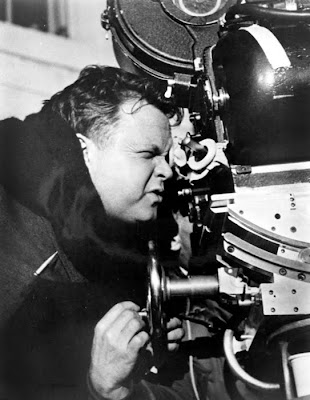
Reflections on a Welles Retrospective Part II


Here's the second part of my reflections on AFI's recent retrospective Larger Than Life: The Films of Orson Welles. For part one click here.

7. We're always harder on The Stranger than we should be. Perhaps because it was Welles's one attempt at a big traditional studio thriller, I'm always a little flippant about it. Most Wellesians dismiss it. And Welles himself treated it like an especially unloved child. I must report, though, that when I watched it on the big screen, I enjoyed it from start to finish. And so did the audience I saw it with. Welles was incapable of filming an uninteresting shot, and set pieces like the long, one-take murder in the woods have an undeniable energy. The movie is no one's idea of a masterpiece--least of all the man who made it--but it's fun. Read more about The Stranger here.

8. You can almost feel Welles's heartbeat when you watch Touch of Evil. It was his last stopover in the Hollywood system before permanent exile, and he clearly made the most of the opportunity. Working with a decent budget, big stars and--most importantly perhaps--an experienced crew, he made a jolting, sleazy noir masterpiece. My experience of seeing this film the other night was one of the great moviegoing experiences of my life. I saw a late showing in AFI's historic Theater One, a huge, beautiful room with a large screen. There were about five patrons there at that hour, just four strangers and me sitting in the dark late one Thursday night watching Charlton Heston and Janet Leigh descend into Welles's nightmare border town. I couldn't have been happier. More more about the film here.

9. The Trial is a dark, impenetrable film. It's an oddity among Welles's films--which is to say it's an oddity among oddities. Adapted from Kafka's book, it tells the story of a man (played by Anthony Perkins) accused of a unknown crime. It's a parable about the arbitrary nature of power and the law, and that makes it something of a sermon. It's the heaviest film Welles ever made, and it may well be his least accessible. It's also a masterpiece, albeit a brooding, difficult one. Watching it on the big screen was a joy--it's a gorgeous film, one that envelops you in a world every bit as bizarre and artificial as Oz. The scene where two men are stripped and whipped in a storeroom is creepy on the small screen, but on the large screen it's terrifying. The whole film becomes scarier on the large screen--and, oddly enough, funnier as well. Bonus: you can make out sexy Romy Schneider's mustache.


10. F For Fake was Welles's last completed film, and it gives a fascinating idea of where the director might have gone with his art if he'd had the money. The film is hard to classify--it's been called both a documentary and an "essay film"--but I regard it as a piece of creative nonfiction. It blends together documentary footage, interviews, dramatic recreations, and almost Expressionistic set-pieces for a meditation on art, forgery, and expertise. Welles starts by looking at the career of the world famous (or world infamous) art forger Elmyr de Hory, the subject of a book called Fake by Clifford Irving, who himself was shortly to become notorious as the author of a bogus biography of Howard Hughes. Welles follows this swirl of events and uses them to ponder several questions about the nature of art: What is the value of authorship? If no one knows the difference between a real masterpiece and a fake masterpiece, then is there a difference? Are critics and experts merely con men pretending to know what art "is" so that they can have a job teaching the rest of us? All good questions, and they make F for Fake an excellent answer to people who accuse Welles of shallowness. This is a profound film.


Of course, it's also a meditation on Oja Kodar's perfectly sculpted ass. Welles's companion and collaborator during the last three decades of his life, Kodar features prominently in this film, mostly as a figure of erotic attention. I bring this up because a) the Oja ass fixation is something that is rarely written about in relation to the film, and b) on the big screen, it is impossible to ignore that this often brilliant film has an entire subplot dedicated to Kodar's ass. Is this simply Welles's overindulging his fixation of Kodar? Is this his way of setting up the last act of the film, the story of Kodar's brief relationship with Picasso? I don't know. I'll have to digest this fact some more before I can form an idea about what it means for the film. Read more about this film--though, sadly, not about Kodar's ass--here.

11. Seeing it on the big screen confirmed what I have long thought: Chimes at Midnight is Welles's best movie. It's the kind of art-house epic he was born to make--intimate in emotion but grand in its ambitions. Unawed by his Shakespearean sources (he fashioned the script from five different plays), unvexed by his limited resources, Welles plunges into the story of Falstaff, that jolly, fat old knight gone to seed on booze, food, girls and good times. He's the "misleader of youth" whose friendship with the callow young Hal, Prince of Wales (Keith Baxter) is a thorn in the side of the King of England (John Gielgud). On the big screen, his gorgeous film unfurls and catches a gust of wind. It's full of huge images: the king's cavernous castle, the battle of Shrewsbury, and Falstaff himself, bloated and jovial.

The centerpiece of the film is the Shrewsbury battle. It's a bravura piece of filmmaking, full of movement and violence and edited for maximum effect. The heart of the film, however, is the tension between the high world of the king's court and the low world of Falstaff's tavern/brothel. This tension was near and dear to Welles, who as an artist was constantly blurring the lines between high and low art, between "literature" and "pulp." While his Falstaff is funny, Welles's genius was to zero in on the tragedy of this supporting character, this instrument of comic relief in Shakespeare's plays, and place him it at the center of a tragedy. As he told Peter Bogdanovich "the closer I got to Falstaff the less funny he seemed to me."

As Falstaff, Welles gave his best performance. If Charles Foster Kane and Harry Lime stand as the great examples of the charisma of the young Welles, then Falstaff stands as the mature culmination of his actor's art. Welles fills the screen here, in more ways than one.

For more on Chimes at Midnight, read this terrific interview with Keith Baxter.