 I have new essay up at Criminal Element about the May 1st release of Lullaby, Ace Atkins first Spenser novel. Is it a good idea to continue the Spenser series after the death of author Robert B. Parker? Is this outright heresy? Or is it something more? Check it out and tell me what you think.
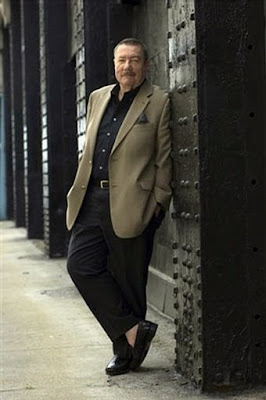 Robert B. Parker, author of the Spenser novels, died unexpectedly Monday morning. He was 77 years old. I first discovered Parker in high school when the natural process of Hammett to Chandler to MacDonald finally led me to Parker. For many people, his detective series focusing on a smart-ass private eye named for the English poet was the natural heir to the great tradition of crime-fighting American heroes.
Parker was his own man, though, and Spenser stood apart from his forefathers Sam Spade, Philip Marlowe, and Lew Archer. When Spenser arrived in The Godwulf Manuscript in the seventies he still smacked a bit of Marlowe and Archer, but as the years went on he began to resemble more and more the man who created him. Parker had a happy--if complicated--marriage to a woman with whom he was almost obsessively in love, so Spenser didn't stay the rugged loner very long. He met Susan Silverman, a romanticized version of Joan Parker just as Spenser was a romanticized version of her husband. Their relationship is the center of the series, a forty year examination of the challenges and glories of monogamy. As Parker had children--two sons, both gay men who work in the arts--Spenser became something of a father figure to two gay men--one a dancer, the other a cop.
Parker had a charmed creative life in which he was able to spin out exciting versions of himself and those he loved and place them within a fictional framework where things like honor and understanding were possible. This is not to say that his novels couldn't be sad--among his best books are a trilogy of novels about Spenser's failed attempts to help a prostitute named April Kyle--but they are redemptive in a way that Chandler would have found unimaginable. Parker's worldview could be warm and optimistic but it was haunted with a realization of the limitations of empathy. No man as good as Spenser ever existed, but Parker created him not as an expression of realism but as an aspiration. That's what a hero is, a secular saint, an unachievable ideal that somehow makes you feel as if such integrity were possible. Being inspirational while being funny and delivering tightly constructed fight scenes is more than most writers achieve.
I will miss Robert B Parker more than I can say. One of the consistent joys of my life was the annual fall release of the new Spenser book. It's tragic to contemplate an end to Spenser, but Parker leaves us 38 Spenser novels. They range from half-dashed entertainments to pop culture gems. He also wrote nine Jesse Stone novels, six Sunny Randall books, two Philip Marlowe books, four Westerns, and seven freestanding novels. That's a hell of a lot of writing. It's also a hell of a gift to his readers. His death is sad for those of us who have found years of comfort in his witty and wise crime novels, but one can only smile when learning that he died at his writing desk. He went out in a blaze of glory. I wrote an extended appreciation of Parker last year. You can read Notes on a Tough Guy's Legacy here.
 I just finished Robert B Parker's new young adult novel Chasing The Bear. The book comes billed as a "Young Spenser" novel. For fans of Parker's perennial private eye series, the idea of a novel looking at Spenser's past will be hard to resist. Alas, the book isn't that great, even for the hardcore Spenser aficionados. It did get me thinking about Parker's legacy, however. Herewith are some thoughts:
1. Here's something obvious to even a causal observer: Parker is insanely prolific. His first Spenser novel appeared in 1973. So far, there have been 36 novels. Chasing The Bear brings the total to 37, and a new Spenser adventure, The Professional, is due out in October. Since that time he's also written two other detective series, a western series, two sequels to Raymond Chandler's Philip Marlowe series, a couple of young adult novels, and seven stand alone novels. All totalled, that's 64 pieces of long form fiction since 1973. And that tally doesn't include the four nonfiction books he's co-authored on subjects like weight-training and breast cancer, as well as a tour guide of Boston. That's an old school working writer, a man spinning out pop-pulp prose like a machine.
2. It ain't all good. One could make the argument that any author churning out that much prose is a hack. Parker is not a hack, but he's delivered more than one bad book. I tried the first Jesse Stone novel and gave up. I skimmed the odd Sunny Randall novel and never really gave them a chance. His Marlowe books are interesting but can't shake the smell of superfluousness. Even his thoroughbred, the Spenser series, has had a few stumbles. Am I incorrect to point out that his books that rely most heavily on Hawk aren't particularly very good? I'm thinking here of Double Deuce and Cold Service.
3. He's the great entertainer. One of the reasons Parker is a great writer is that for every half-assed book he's dashed off he's written two snappy pop-pulp masterpieces. The Spenser series is the most consistently reliable source of entertainment I've had in my life since I picked up Playmates when I was fifteen. I began devouring the books after that, and I've never lost my appetite for them. Parker's a formulaic author--no doubt about it--but it's a formula which keeps calling me back. To skim the surface of the formula: Spenser is a Boston private eye. He's hired in the first chapter or so to do a job (investigate a murder, provide protection, perform surveillance). Around chapter two or three he has dinner with his girlfriend Susan, a Boston shrink. In the ensuing chapters Spenser will begin his investigation, but the case will become unexpectedly complex. Normally, the crime will become bigger than it first appeared, usually with the appearance of numerous thugs, gangsters, or shady government operatives. Spenser will call in reinforcements, starting with Hawk, a hitman who has feelings only for Spenser and Susan. Parker's plots are never terribly important, so while he occasionally crafts a mystery, most of his plots are mere clotheslines for scenes. The scenes fall into a few well established types: Spenser and Susan flirting, Spenser and Susan psychoanalyzing the people they've encountered, action scenes (I've lost count of how many people Spenser's killed but it's well into the double digits), backtalk scenes in which Spenser insults cops, clients, gangsters, pompous businessmen, academics, or religious authorities. Parker writes great action, better dialog, and he drops the best quips in the business. We all wish we could talk to people this way. His books are often laugh out loud funny, but never get too cute.
4. He's something more than an entertainer. Parker took an idea that Chandler had--to use the private detective as a modern American heroic archetype--and burnished it into a shining suit of armor. Spenser is nothing less than Parker's conception of the perfect man. I have to say, he's pretty much my conception of the perfect man, as well. It's isn't that Spenser is a tough guy who cracks wise. Lots of authors have given us those kinds of characters. Parker's unique contribution to the field of private eye heroes is that Spenser is a complete man. He's sensitive without being wishy-washy. He's feminized without losing his masculinity. Spenser is tougher than Mike Hammer (Hammer's meaner, but Spenser would win a fight between the two), but he's also smarter and more knowledgeable about people. I'm not ashamed to say that I've learned as much about life from Parker's pop-pulp detective series as I have from any other author. Parker, a former boxer and weightlifter turned disgruntled PhD (the most consistently withering characterizations in his work are flaccid academics), married a shrink in real life and has two gay sons who are involved in the arts. He's the extremely rare crime writer who is as comfortable writing about femininity as he is writing about masculinity. He doesn't write about gender in terms of binaries; he judges men and women on the same scale of behavior. In Spenser's world, you either get it or you don't get it. Gender, race, position--none of it means much. Either you've kept your eyes opened and learned from what you've seen, or you've gotten drunk on lies and refused to think any further. Spenser doesn't seem politically correct, he just seems wise. You could never use that word to describe Mike Hammer.
Of course, perfection is a myth. One problem with Chasing The Bear is that Spenser doesn't seem plausible as a fifteen year old boy. The book wants to show us how Spenser "became" Spenser, but he seems pretty much fully formed when we meet him. Worse, his back story involves a father and two uncles who themselves are examples of some kind of race of supermen. Parker can write human characters (see his overlooked 1994 family/cop saga All Our Yesterdays), but he's more interested in modeling his conception of virtue. As someone who has learned quite a bit about life from his example--namely Spenser's example--I don't think that's too much of a problem.
*
Where to start reading Parker?
The best place to begin is at the beginning, with Spenser's first adventure, The Godwulf Manuscript. It's an interesting read because the Chandler influence is all over it. Parker's first few books are good and well worth reading, but I think he hit his stride on book seven with Early Autumn. Years later he wrote a sequel-of-sorts to Early Autumn in book eighteen, Pastime. Another good series within the series is the saga of Spenser's dealings with a prostitute named April Kyle. April first appears in Ceremony (book nine), then in Taming A Sea Horse (book 13), and finally in Hundred-Dollar Baby (book 34). Her story is a tragedy unfolding over a series of years, and the storyline brought out the best in Parker.
What about other media?
I used to watch Spenser: For Hire when I was a kid but revisiting them has always been a letdown. The network never quite understood the character, I think. Robert Urich was good as Spenser without being great. And I'm not sure who thought pudgy Joe Mantenga--as fine an actor as he is--could play Spenser. Likewise, Spenser has received the Mantenga treatment on audiobooks and the result hasn't been great. Parker's quips fumble their way out of Mantenga's mouth and, curiously, he's even less convincing when he's reading the tough guy passages. Since Mantenga's been reading the books for about ten years now, Parker must like him, but I've yet to see or hear a Spenser production that lives up to the books. Maybe someday.
Ed Harris did Parker correctly in his adaptation of the author's western novel Appaloosa.
*
Here's a fun print interview with the author.
And finally, here's a grainy audio interview with him.


