Thursday, May 19, 2016
The Rebirth of TOO LATE FOR TEARS
The 1949 TOO LATE FOR TEARS was one of the first discoveries I made when I began my descent into the dark universe of film noir. I've written about the film several times: in my book THE BLIND ALLEY, in a tribute to Lizabeth Scott in the pages of MYSTERY SCENE magazine, and on this blog. The first conversation I ever had with film noir guru Eddie Muller was about this film. I have loved TOO LATE FOR TEARS for years.
All of which is to say that the resurrection of this long forgotten--and for all intents and purpose, this long lost--film noir is something that I regard as pretty close to a miracle.
The film itself is a bizarre creation. It was made by a producer (Hunt Stromberg) whose best--or at least most successful--days were behind him. It was a showcase for a star (Lizabeth Scott) whose career had never really taken off and would quickly come to an end. Its director (Byron Haskin) was talented but even today he remains widely unknown to all but the most hardcore movie geeks. The most successful person associated with the film was undoubtedly the writer Roy Huggins, who would go on to amass a legendary career in television. The most amazing thing about this list of talent is that all of these people, at one time or another, to one a degree or another, more or less disowned the film.
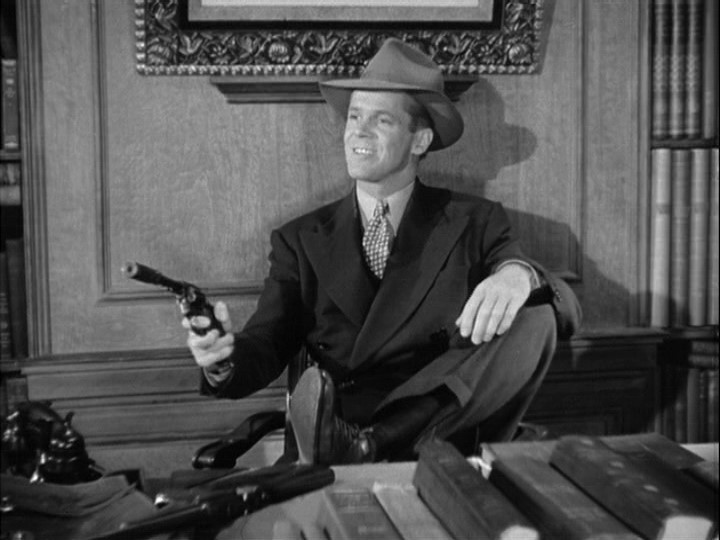
So how did an obscure cheapie come to be resurrected? Well, the easy answer is that the movie is a masterpiece that couldn't be denied. There are a few noirs that are as good as TOO LATE FOR TEARS but there aren't many that are better. The film is the finest moment not only of Lizabeth Scott, one of the greatest of all noir women, but also of her costar Dan Duryea, one of the greatest of all noir men. It is suspenseful, it is frequently laugh out loud funny, and it has depth and humanity. Scott and Duryea play a mismatched housewife and conman who attempt to get away with $60,000 in blackmail money, and their scenes together are some of the most entertaining moments you'll see in a film noir. I saw the film at Noir City Chicago a while back and it killed with the audience.
There is a more complicated answer to why this film has endured and it's a story that is well told on the brand new BluRay and DVD package that's just been released by Flicker Alley, in cooperation with the UCLA Film and Television Archive and the Film Noir Foundation. This package is a must have for any film noir fan. It contains a new digital version transferred from a new 35mm print of the film. For fans of the film who have made do with cheap digital versions based on scratched and faded prints, this package is a revelation. The set also includes new featurettes on the making of the film and on the story of its rescue and restoration. It contains interviews with folks like Eddie Muller, Kim Morgan, and Julie Kirgo, as well as feature commentary by Alan K. Rode, and an excellent essay by noir expert Brian Light.
There is a lot of hand-wringing about the future of cinema and the loss of film culture, but there are still miracles. The rebirth of TOO LATE FOR TEARS is one of those miracles.
Sunday, January 26, 2014
A Forgotten Masterpiece Restored: TOO LATE FOR TEARS (1949)
Jane Palmer (Lizabeth Scott) is definitely bad news but TOO LATE FOR TEARS makes the diabolical suggestion that there might be a femme fatale hiding inside the ostensibly happily married woman. Like DOUBLE INDEMNITY this film sees the married woman—the symbol of fertility and domestication in most American films of the forties and fifties—as a cold blooded murderer lying in wait. Jane Palmer and Phyllis Dietrichson could be sisters.
One last word on Byron Haskin. A professional who worked in Hollywood as a special effects man, cinematographer, and director, Haskin is a mostly forgotten figure today. When he is remembered it is usually in conjunction with his extensive work in science fiction (he directed WAR OF THE WORLDS in 1952 and worked on the pilot episode of STAR TREK), but his contributions to noir are top rate. In addition to TOO LATE FOR TEARS he directed Liz Scott, Burt Lancaster, and Kirk Douglas in the terrific 1947 I WALK ALONE. He also directed John Payne’s best performance in the political drama THE BOSS in 1956. All these films are worth finding, and Haskin deserves to be remembered.
Sunday, December 16, 2012
Dangerous Dan Duryea
Read more about the king of heels in my new piece on Duryea over at Criminal Element.
Friday, June 26, 2009
Manhandled (1949)
After watching a good Dan Duryea performance, I’m always reminded of Dashiell Hammett’s description of Sam Spade in The Maltese Falcon: “He looked rather pleasantly like a blond Satan.” Duryea’s charisma was a giddy superficiality masking an inner demon. This guy would slap around his own mother if it’d make him a buck. Like Kirk Douglas, he excelled at playing sons of bitches. He never became a leading man the way Douglas did, but he redeemed a lot of movies in the course of his career.
Case in proof is Lewis Foster’s 1949 Manhandled. The film begins with a writer played by Alan Napier who has been having recurring dreams about murdering his wife and making off with her jewelry. He goes to see a sham psychiatrist whose morally ambiguous secretary Merl (Dorothy Lamour) tells her downstairs neighbor about the dreams and the jewelry. Unfortunately, her neighbor happens to be a sleazy con man named Karl Benson (Duryea). Soon, the wife is found murdered, her jewelry missing. A smart cop (Art Smith) and a smartass insurance investigator (Sterling Hayden) look into the case, and before long their investigation starts pointing them to the secretary.
Manhandled is fun, but the plot is all over the place. Our sympathy is supposed to lie with Merl, but after setting up her character with a shady past, the film never really resolves that shadiness. Lamour was well known for her comedies with Hope and Crosby, but here she’s out of her element and turns in a bland performance. Sterling Hayden, on the other hand, looks like he’s having a good time as the insurance investigator, though for some reason his first two scenes inexplicably have him getting dressed in public, even while questioning suspects. Art Smith is as likable as always as the smart cop, but while the script gives these investigators a lot of banter, it doesn’t give them much to do.
Director Lewis Foster had the kind of journeyman career that was only possible in the old days of Hollywood, back when a person could be a jack of all trades. He started out as a comedy specialist in the twenties and thirties, directing shorts with Laurel and Hardy. Throughout the forties he worked primarily as a screenwriter, contributing to a variety of projects, including musicals. Then from the fifties to the end of his career, he switched back to directing, mostly Westerns. His few excursions into noir territory aren’t bad, but they don’t exactly demonstrate an instinctive feel for the material. He’s not helped by Manhandled’s goofy script (the psychiatrist has a secretary sit in on sessions? the cops have a car without working brakes?), though he is aided considerably by Ernest Laszlo’s cinematography.
At the end the day, however, the movie is saved by Duryea. His presence here is a blessing for a couple of reasons. First, since Duryea is the only one who knows what’s going on through most of the movie he becomes the de facto main character. Our identification with him makes the film more fun and also makes it more of a noir. It’s a hoot to watch this two-bit shyster working three or four different angles at once. And secondly, Duryea simply gives the best performance in the movie. He’s playing the same charming sleazeball he usually does—lying his face off, terrorizing women, talking fast and hatching schemes. He did this kind of thing better than anyone else, and the effect of it is only enhanced the more you’ve seen it before. Manhandled would be a fine introduction to the actor, but it will play even better if you’ve already seen Scarlett Street and Too Late for Tears.
It is a particular challenge to explain to the uninitiated just how Duryea’s charm works. Historian Eddie Muller has reported that in the forties the more Duryea slapped around women onscreen, the more fan mail he received. There’s nothing charming about misogyny, so why was Duryea a sex symbol? Part of it, I think, is that Duryea’s nastiness had a distinct shallowness to it. When Kirk Douglas was a son of a bitch onscreen, you believed it. You felt the disturbing pull of real anger there, and there usually comes a moment in a Douglas performance where he drops the charm and explodes with rage. Duryea is different. He never drops the charm for very long because charm is the chief weapon in his arsenal. He’s a coldblooded son of a bitch, but he’s always on the make.
Like a blond Satan.
*
Here's a fun piece on Duryea.