I fear that we will never look upon the likes of STAR TREK IV: THE VOYAGE HOME again. Remember that this fourth entry in the venerable franchise was a radical departure from what came before it. Where STAR TREK: THE MOTION PICTURE was a bloated attempt to turn Trek into a Kubrickian LSD trip, and WRATH OF KHAN was a submarine picture, and SEARCH FOR SPOCK was a heist movie crossed with a religious epic, THE VOYAGE HOME is, of all things, a gentle comedy.
Curiously, of all the Start Trek feature films, it is the one that most closely resembles the original series. People remember it as "the one with the whales" because the plot centers around a return to the past (ie. the then present, 1986) to retrieve a couple of humpback whales in the hopes that the extinct leviathans can communicate with a probe that is destroying the earth. The time travel plot (and its twin sibling, the "let's go to a planet that resembles an era in Earth's past" plot) was a mainstay of the original series. But so was the comedy episode. Something like "A Piece of the Action," in which Kirk, Spock and McCoy beam down to a planet that has patterned itself after the gangsterism of 1920s Chicago, combines both the time travel plot and the comedy approach. STAR TREK IV, in some ways, owes more to those kinds of episodes than it does to TREKs 1, 2, and 3.
(This is where I should point out that THE VOYAGE HOME does complete the Genesis Trilogy, that trilogy within the series that begins with the introduction of the Genesis device and the death of Spock in WRATH, follows Spock's resurrection on the Genesis planet in SEARCH, and culminates with the return to Earth in VOYAGE.)
Because THE VOYAGE HOME was the most successful film in the franchise until the 2009 reboot, it's easy to lose sight of the fact that the initial decision to make the film a comedy was a potentially disastrous decision. Parts 2 and 3 had blacked-hatted villains, disgusting desert slugs oozing out of people's ears, battles in space, exploding planets. Part 4 features word play and fish-out-of-water (no pun intended) slapstick. It all could have gone so wrong.
(Another aside: it almost all did go wrong. An early idea for the movie featured Eddie Murphy as a whale expert who gets involved with the crew. This version of the story was given very real consideration, and Murphy was briefly attached to the project, before the idea was abandoned and the character was changed to a love interest for Kirk. One can respect Eddie Murphy was as a comedy legend while still suspecting that stunt casting him in a Star Trek movie in 1986 would have been bad for everyone involved.)
Instead, what the filmmakers gave us was a perfect kind of Star Trek episode, one that relies on sharply drawn personalities and witty dialogue for its effects. Shatner, Nimoy, Kelley were always a great comedy team, but here the rest of the cast get to flex their comedy muscles as well.
It's all kind of perfect. Yes, THE WRATH OF KHAN is a pop sci-fi masterpiece and the best of the Trek films. It's the one that will have the longest life. Just recently a theater here in Chicago played KHAN as part of their "Nerdy November" late night movie series. When I saw that (which is what prompted this little blog post), I thought. "That's wrong. If you want to be nerdy, show THE VOYAGE HOME." In a way, it's the most Trek of the Trek movies.
Which brings me back around to my original point. We'll probably never see another Trek movie like this again. It's too big of a risk today. VOYAGE cost 21 million dollars to make. The last reboot film, STAR TREK BEYOND, cost a whopping 186 million. The new films use humor, but the idea of giving an entire installment in the series over to characters, conversation, and laughter (with the requite sci-fi bookends, of course) would never fly today. Today Trek has to, in theory at least, compete with Star Wars installments and Marvel movies. It has to be big. VOYAGE, by contrast, had scope when it needed it, but was mostly content to be intimate.
Even more radical, VOYAGE doesn't have an enemy. Think about that for a moment. There's no violence, just suspense and comedy. One of my bones of contention with the direction that Star Trek has taken since the original cast retired is its slavish devotion to the revenge plot. This is an unfortunate legacy of KHAN. The main driver of the last four (!) Trek films--starting with the series nadir NEMESIS in 2002 and extending through all three of the reboot films--has been the revenge plot. Someone returns from the past to get revenge. One wants to tell the filmmakers, for god's sake stop trying to remake KHAN. Is is beyond tiresome at this point. It's malpractice. One can only hope that Noah Hawley will watch STAR TREK IV again. I don't expect the next Trek film to be a comedy about whales, nor would I want it to be. I'm not asking for another rehash. What I am suggesting is that Star Trek has durable characters and a tradition of being open to risky ideas. Trying boldly going in that direction?


Reading about the recent dust up between Martin Scorsese and Marvel fans, I couldn't help but think of Cecil B. DeMille's 1956 THE TEN COMMANDMENTS. It's a film that Scorsese admires and that he showcased in his documentary A PERSONAL JOURNEY THROUGH AMERICAN FILM (1995). It's a finely crafted big budget spectacular. It's also a pretty bad film. What I mean is, no one watches THE TEN COMMANDMENTS today and thinks of it in anything other than genre terms. It's not a serious statement of religious conviction, it's not psychologically rich, and it's not a great work of cinema. Instead, it's the biggest of the biblical epics, the popular movie genre that dominated big screens in the 1950s. And biblical epics were, basically, proto-superhero movies. They have most of the qualities that we associate with superhero movies: square-jawed heroes with fantastic abilities, impressive special effects, romantic subplots, broad action and drama, and characters that fall pretty easily into the categories of good and bad. (About the only thing from the standard superhero tool kit that THE TEN COMMANDMENTS is missing is comedy, because DeMille didn't have a sense of humor.) I suspect Scorsese is probably making allowances for Moses that he won't make for Iron Man because he formed an attachment to the biblical epics as a kid. As a child, he looked past their goofiness and their shallowness because all he saw was their size and spectacle. The symbolism of the Bible writ large on the big screen fired his imagination, and that initial awe and wonder has stayed with him. The same is undoubtedly true of people who love comic book movies. Where they would watch THE TEN COMMANDMENTS and might only see stodgy cheese, they look past many of those same qualities in their beloved comic book movies because they bonded with those stories and characters as children.
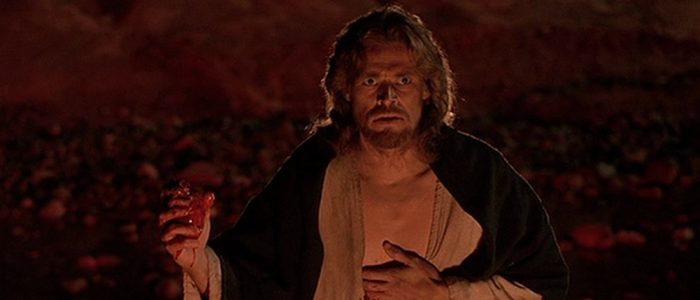
Something else that has inspired these reflections is that I rewatched Scorsese's THE LAST TEMPTATION OF CHRIST the other day. It's a fascinating film, and part of its fascination is that despite all of its controversy, in its heart it's kind of another cheesy biblical epic. It's dealing with deadly serious theological issues, but, I don't know, every time Harvey Keitel opens his mouth to debate Jewish law, I laugh. When the snake tempts Jesus in the desert with "Look at my breasts. Ooh Jesuuus," I laugh. And pretty much every time Peter Gabriel's very '80s score kicks in, I laugh.

Something that THE TEN COMMANDMENTS and a movie like AVENGERS: ENDGAME have in common is that they both essentially exist to do fan service. (THE TEN COMMANDMENTS was the only movie my fundamentalist grandfather liked, probably because it was designed to give him exactly the version of Moses he expected to see. Most comic book fans love ENDGAME for the same reason.) In this crucial respect, though, THE LAST TEMPTATION OF CHRIST is different. Scorsese made a film that appealed to a very narrow sliver of the moviegoing public. He made a biblical epic that would antagonize the kind of people who usually like biblical epics, without necessarily attracting many people who don't like biblical epics. Along with Kevin Smith's DOGMA, it belongs in a tiny subgenre we might call Subversive-Catholic fanfic cinema. These are works of supremely idiosyncratic theological obsession.
I don't know if the superhero movie could really lend itself to this kind of treatment. Something like UNBREAKABLE is certainly a rethinking of the superhero movie, but it's not working from well known pre-existing characters. And, no, JOKER doesn't count, either. JOKER is a massive testament to fan service. It gives fans of the character exactly what they want to see (to the tune of about 745 million dollars and counting). Perhaps one day when Iron Man and Joker and all the rest of their superhero/villain brethren slip into the public domain alongside Jesus and Moses, we'll see if something truly challenging could be done with them. That should be interesting.
For now, we're stuck with the world as it is, a world dominated by superhero movies. In a way, I'm okay with that. I like many of these movies, and I suppose that whether they wear capes or togas, superheroes have pretty much always dominated movie screens. Having said that, it's also true that most great cinema addresses itself to the rest of us mere mortals, living our little lives down here below without the benefit of either infinity stones or parting seas.
Above: Some handsome son of a bitch.
I had the pleasure of being interviewed by Scott Alderberg over at Criminal Element. We discuss DRY COUNTY, which leads us into questions of religion, politics, and the origins of evil. In other words, fun stuff. Check it out here.
The 1950s were the great heyday of movies about preachers gone bad. Today, I'm over at Criminal Element trying to answer why that is. Check out my piece "Criminal Clergy: Depictions of Religion in 1950s Film Noir" here.
My novel DRY COUNTY will hit bookstores on October 1st. That night there will be a book launch at City Lit Books from 6:30-8:30. If you're in Chicago or surrounding environs, I hope you'll come by.
One of the highlights of my moviegoing year--hell, one of the highlights of my year, period--is Noir City Chicago. This is the festival where the Film Noir Foundation rolls into town and sets up shop at the Music Box Theater, showing a selection of classic film noir curated and and presented by Eddie Muller and Alan K. Rode. These events are always a blast, and this year looks to be no different. The festival this year focuses on the noirs of the 1950s, and the showings are all double bills. Must-see double bills for me include: IN A LONELY PLACE & THE FILE ON THELMA JORDAN, PUSHOVER & PRIVATE HELL 36, and ODDS AGAINST TOMORROW & CRY TOUGH. Check out the rest of the line up at the Music Box's festival webpage.
Orson Welles's adaptation of Shakespeare's OTHELLO is a film of unusual beauty. Even among the work of a visual master like Welles, it stands out. I don't want to linger on the incredible story of the film's production, which took place on two continents over three years and is a legend in its own right (Welles himself covered this territory in FILMING OTHELLO). Though it's worth noting the frantic, often desperate circumstances that Welles, his cast, and his crew, found themselves in, what matters is what was produced by those trials: this strange and beautiful film.
Before I go further, I need to say that I'm going to be writing here about the 1952 European version of the film rather than the 1955 US/UK version. Both versions were edited by Welles, so both stand as a "director's cut." It's fascinating to compare them, to see two different ideas Welles had for the film. In 1955, Welles redubbed the entire performance of Suzanne Cloutier (as Desdemona) with the voice of actress Gudrun Ure, as well redubbing about half of his own lines. He cut the spoken credits that had begun the film, clipped some dialog, and added some brief bits narration to set up the plot.
For my money, the 1952 version is superior, and not just marginally so. The changes Welles made in 1955 produced a less compelling picture overall. His spoken credits in the '52 version allow for a much smoother transition between the tour de force opening funeral march and the beginning of the story proper. I've always considered the first dialog scene in the '55 version--where Iago and Rodrigo spy on Othello's wedding to Desemona--to be choppy and awkward. And Welles's narration in these opening scenes has always seemed to be an obvious patch, explaining things in the narration to cover over the confusing editing. In the 52 version, by contrast, the opening scenes get to breathe a little, and they play better without the expository, and largely unnecessary, narration. Welles also includes a line from the play that helps set up Iago's hatred of Othello ("It is thought abroad that 'twixt my sheets he has done my office") that was cut in the 1955 version.
The larger change, of course, is the redubbing of Othello and Desdemona's dialog. There is, I will admit, a case to be made here for the '55 version. What Welles did in redubbing the dialog was to replace the elegant and meek Cloutier with the more forceful Ure. To match this Desdemona's new strength, he made his readings of Othello's dialog angrier and more macho. Some viewers will prefer this more "passionate" performance of the material.
But I think it worked better in 52. Cloutier's vocal performance of the material better matched her physical portrayal of Desdemona as a sweetly innocent girl. And Welles, in turn, responded to that portrayal by giving us an Othello that was a softer, sadder man driven crazy by jealousy. In '55, she's louder and he growls his lines more, but, in this case, less really was more.
One of the great joys of a Wellesian Shakespeare adaptation is Welles-the-screenwriter's lack of intimidation in the face of such a classic. He takes his scissors to the play and makes it work as a screenplay, clipping lines or rearranging them, sometimes just shaving off a word here and there, other times jettisoning whole speeches. If one wants to savor the Bard's original language, this is not the film to see.
Because what Welles does instead is to interpret the work as a piece of cinema, not just as a recorded performance of a play. Shot by shot, scene by scene, his visual compositions are a delight. Over the course of the production the director worked with five (!) cinematographers, but there can be no doubt that Welles himself was the eye behind the camera. From the opening funeral march, to the attempted assassination of Cassio in the Turkish bath, to the final scenes of Desdemona's murder and Othello's suicide, Welles creates rich, vivid images. Working in certain motifs throughout the film--prison bars and distorted mirrors--he varies angles on shots about as often as he cuts, giving the film a dynamic energy. And speaking of editing, scholars who have done the counting have calculated that OTHELLO has almost 2000 individual cuts, compared to 500 or so for CITIZEN KANE. While the cutting is a direct result of the circumstances Welles was working under, the film is unified by a vision. OTHELLO, after all, is a movie about the center not holding, about love and trust and friendship falling apart in a frenzy. And the movie itself reflects that idea visually.
Coultier is sweetly touching as Desdemona, but Welles is not a great Othello. Although his performance in the '52 version is superior to the '55, either way OTHELLO is a director's picture rather than an actor's picture.( This was true, also, of Welles's MACBETH a few years earlier. His Shakespearean triumph was, of course, FALSTAFF, a film that manages to be both an actor's picture AND a director's picture.) As both Macbeth and Othello, Welles is more declamatory than deeply felt, and his characterizations rarely go beyond a surface level reading of the roles. (Again, compare this to his more lived-in portrayal of Falstaff, the most moving performance he ever gave.)
The one great performance in the film is given by Micheal Mac Liammoir, the legend of the Irish stage who had been a mentor to Welles when the actor was just starting out as a teenager. Mac Liammoir's performance is the one that lingers after the film is over. As Iago, he creates a delicious vision of wily evil, of internalized malice and outward cunning. He seduces everyone else in the film, and even when he's finally caught and imprisoned in a swinging cage to watch Othello's body carried off for burial, his secrets are still his own.